Quick Facts
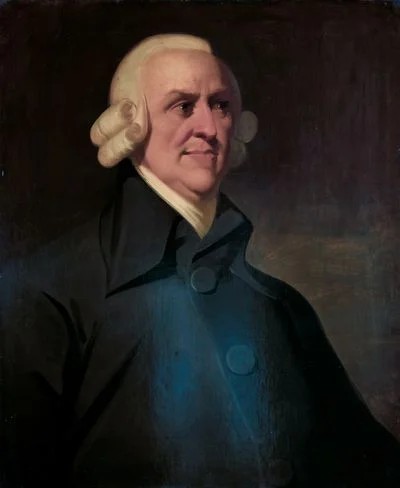
Invisible hand. Free markets. Father of modern economics who explained how nations grow wealthy.
Conversation Starters
Life Journey
Adam Smith was born in Kirkcaldy, Fife, to Margaret Douglas shortly after his father, a customs official, had died. His exact birth date is unknown, but he was baptized on June 5, 1723.
As a young child, Smith was briefly abducted by a band of Romani travelers but was quickly rescued. This dramatic incident became a famous anecdote in his biography.
Smith enrolled at the University of Glasgow at age 14, where he studied moral philosophy under Francis Hutcheson, whose lectures on ethics profoundly influenced his thinking.
Smith won a scholarship to Balliol College, Oxford, where he spent six years. He found the teaching quality poor compared to Glasgow and largely educated himself through extensive reading.
After leaving Oxford without completing his degree due to ill health and dissatisfaction with the university, Smith returned to his mother in Kirkcaldy seeking direction for his future.
Smith began delivering public lectures on rhetoric and belles-lettres in Edinburgh under the patronage of Lord Kames, establishing his reputation as a thinker and speaker.
Smith met the philosopher David Hume, beginning one of the most important intellectual friendships of the Scottish Enlightenment that would last until Hume death in 1776.
Smith was appointed Professor of Logic at the University of Glasgow, and the following year transferred to the Chair of Moral Philosophy, which he held for 13 years.
Smith published his first major work, exploring human morality and sympathy. The book was an immediate success and established his international reputation as a philosopher.
Smith resigned his professorship to become tutor to the young Duke of Buccleuch, traveling through France and Switzerland. The generous salary provided lifelong financial security.
In Paris, Smith engaged with leading intellectuals including Voltaire, Turgot, Quesnay, and other physiocrats whose economic ideas influenced his own developing theories.
After the tour ended tragically with the death of the Duke younger brother, Smith returned to Kirkcaldy where he spent nearly ten years writing The Wealth of Nations.
Smith was elected to the prestigious Literary Club in London, whose members included Samuel Johnson, Edmund Burke, Edward Gibbon, and Joshua Reynolds.
Smith published An Inquiry into the Nature and Causes of the Wealth of Nations, the foundational work of classical economics that would profoundly influence economic thought for centuries.
Smith was appointed Commissioner of Customs in Scotland, a position he held until his death. Ironically, the advocate of free trade spent his final years enforcing trade regulations.
Smith was elected Lord Rector of the University of Glasgow, a prestigious honorary position that recognized his contributions to learning and his association with the university.
Adam Smith died in Edinburgh after a painful illness. Before his death, he had most of his unpublished manuscripts burned, fearing they were not ready for publication.