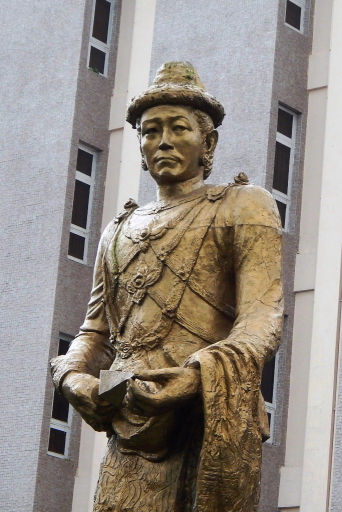
Quick Facts
A village headman turned conqueror who reunified Burma, founded the Konbaung dynasty, and challenged regional empires.
Conversation Starters
Life Journey
Aung Zeya was born in Moksobo, a rural settlement in Upper Burma’s Mu valley. He grew up amid Ava-era political fragmentation, learning local leadership in a landscape of rival chiefs and shifting allegiances.
By his teens and early adulthood, Aung Zeya gained influence as a local headman, organizing manpower and agriculture in the Mu valley. His standing rested on personal authority and networks of patrons and allied households.
After the Mon-led Restored Hanthawaddy forces captured Ava and toppled the Taungoo court, Aung Zeya refused submission. He mobilized local fighters, fortified Moksobo, and framed the struggle as the defense of Upper Burma.
Aung Zeya adopted the royal title Alaungpaya and established a new center of power in Moksobo. He began transforming village levies into a disciplined army, recruiting officers through loyalty and battlefield success.
Alaungpaya expanded and fortified Moksobo, later known as Shwebo, to serve as his capital and recruitment hub. Stockades, supply depots, and new administrative practices helped him sustain campaigns far beyond the Mu valley.
With Upper Burmese chiefs increasingly aligned to him, Alaungpaya pushed south along the Irrawaddy corridor. He used rapid marches and negotiated submissions to isolate Hanthawaddy garrisons and seize strategic river towns.
Alaungpaya took the port town of Dagon and renamed it Yangon, signaling a new political order in Lower Burma. Control of the river-mouth region strengthened his access to trade, arms, and maritime approaches.
After securing Yangon’s hinterland, Alaungpaya pressed into Mon country, dismantling Hanthawaddy strongholds. His commanders combined siegecraft with offers of clemency, aiming to split opponents and absorb manpower.
Alaungpaya’s forces captured Pegu, the Restored Hanthawaddy capital, ending its bid to dominate Burma. The victory reunified much of the kingdom under his rule and marked the decisive rise of the Konbaung dynasty.
With Lower Burma subdued, Alaungpaya reorganized appointments and revenue flows to bind newly conquered territories to the royal center. He rewarded loyal officers with posts while placing key towns under trusted commanders and relatives.
Alaungpaya moved forces toward Manipur to counter raids and reassert Burmese influence in the borderlands. These operations aimed to control routes linking the Irrawaddy basin to the northeastern hills and regional tribute networks.
At Syriam, Alaungpaya confronted foreign-backed resistance and the flow of firearms into Mon-held positions. The episode reflected the wider contest among European trading interests in the Bay of Bengal and Burma’s coastal ports.
Alaungpaya pushed into the southern corridor toward the Tenasserim coast to secure overland access to ports and curb Siamese influence. The moves tightened control of the long frontier zone where Mon, Burmese, and Siamese interests overlapped.
Alaungpaya led a major expedition into Siam, driving forces toward the Ayutthaya heartland to project power and secure border leverage. The campaign strained logistics and exposed his army to disease, supply shortages, and fierce resistance.
During the retreat from the Siam front, Alaungpaya became gravely ill, with later accounts linking his decline to the campaign’s hardships. His condition forced commanders to prioritize withdrawal and succession planning amid a tense military situation.
Alaungpaya died in 1760, leaving a rapidly expanded kingdom and a powerful new dynasty. His son Naungdawgyi inherited the throne, facing the immediate task of stabilizing conquests and managing ambitious military elites.