Quick Facts
A steppe-born rebel who forged Parthia’s independence and founded a dynasty that challenged Seleucid power for centuries.
Conversation Starters
Life Journey
Arsaces was born into the Parni, a mounted warrior people linked to the Dahae on the northeastern Iranian steppe. Raised in a mobile, clan-based society, he learned raiding, diplomacy, and survival on the frontier of Hellenistic power.
In youth he trained with composite bow and spear, mastering rapid cavalry tactics typical of Parni warfare. Steppe mobility and clan loyalties shaped his leadership style and later Parthian military identity against Seleucid-style infantry armies.
News of Antiochus II’s death and the Seleucid succession crisis spread across the eastern satrapies. Arsaces’s circle watched local governors grow bolder, sensing an opening for rebellion in Parthia far from the Mediterranean court politics.
Ancient traditions place his rise to command around the moment later Parthians counted as their dynastic beginning. With Parni chiefs and allied riders, he began moving from steppe grazing lands toward settled Parthia, aiming at seizure rather than tribute.
To hold disparate clans together, Arsaces used steppe tools of power: hostages, gift exchange, and marriage alliances among leading families. These bonds created a stable war band capable of sustained campaigning beyond seasonal raiding.
As Parni riders probed Parthia’s borders, they clashed with Seleucid patrols and local garrisons guarding caravan routes. Arsaces learned the terrain of oases and mountain passes, favoring ambush and withdrawal over set-piece battle.
Arsaces pushed into Parthia during years when Seleucid attention was diverted by western wars and internal rivals. He targeted the satrap’s networks of taxation and garrison supply, undermining Hellenistic administration before attempting a decisive takeover.
Sources associate Arsaces’s breakthrough with the fall of Andragoras, the local governor who had acted independently of Seleucid kings. By combining cavalry shock with pressure on towns, Arsaces removed the satrapal regime and claimed Parthia for his house.
After securing key centers, he adopted royal status and the name that later rulers repeated as a dynastic title, “Arsaces.” The new monarchy fused steppe leadership with Iranian kingship traditions, presenting independence from Seleucid overlordship.
Arsaces is linked with early Arsacid centers near Nisa, where storage, armories, and fortifications supported a mobile court. By anchoring his cavalry power to protected bases, he ensured the kingdom could withstand seasonal invasions and sieges.
He sought legitimacy among local Iranian landholders and town leaders who had lived under Achaemenid and then Hellenistic systems. By confirming privileges and demanding loyalty, Arsaces reduced resistance and turned former subjects into stakeholders of the new order.
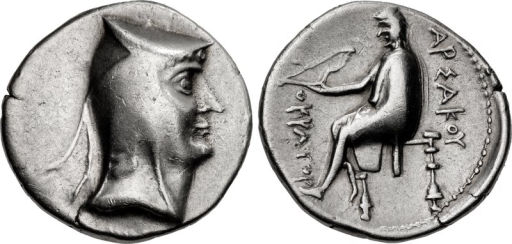
Early Arsacid coinage, modeled on Hellenistic forms but asserting a new royal identity, helped broadcast authority across trade routes. Coins circulating through markets and garrisons signaled that Parthia now answered to a king, not a Seleucid satrap.
Seleucid leaders attempted to reassert control in the east, but distance and competing crises limited sustained campaigns. Arsaces relied on cavalry harassment and fortified refuges, preserving his hold until Parthian independence became a political fact on the ground.
With Parthia secured, Arsaces pressed into neighboring Hyrcania to control fertile lands and routes along the Caspian edge. This expansion broadened his tax base and recruitment pool, while tightening control over movement between Iran and Central Asia.
Tradition credits his brother Tiridates with continuing or stabilizing Arsacid rule, suggesting a shared family project rather than a lone conquest. Arsaces’s arrangements for succession and clan loyalty helped the dynasty survive beyond a founder’s lifetime.
Arsaces died after laying the foundations of a kingdom that would later rival Rome and reshape the Near East. His legacy endured in the royal title “Arsaces,” adopted by successors to claim continuity with the dynasty’s steppe-born founder.