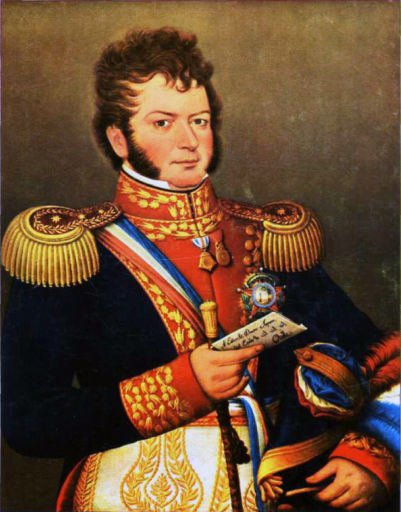
Quick Facts
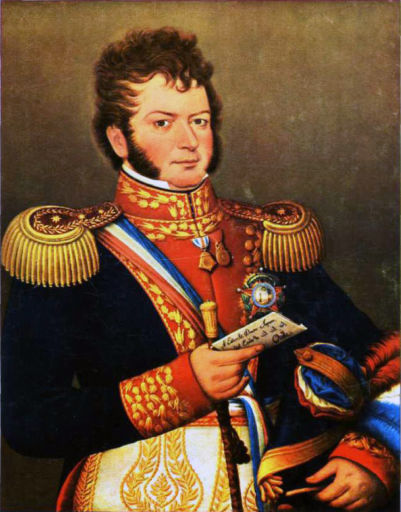
Chilean independence leader who forged a new republic through daring campaigns, stern reforms, and uneasy alliances.
Conversation Starters
Life Journey
Born in Chillan to Isabel Riquelme, he was the son of Ambrosio O'Higgins, an Irish-born Spanish colonial official. His illegitimate status shaped his early life, while his father's rise in imperial service foreshadowed a complex legacy.
As Bourbon reforms tightened colonial administration, he pursued education away from the frontier society of southern Chile. Exposure to Enlightenment-influenced circles began to challenge traditional loyalty to the Spanish crown.
He traveled to Europe during an era when Atlantic politics were unsettled by the French Revolution and imperial wars. In cosmopolitan settings, he encountered debates on sovereignty, commerce, and republican government that later informed his politics.
In London he met fellow Spanish Americans and heard arguments for autonomy that circulated among expatriates and merchants. These discussions helped him imagine Chile as a polity capable of governing itself rather than a distant appendage of Madrid.
Back in Chile, he took responsibility for hacienda affairs and gained practical experience with land, labor, and local patronage networks. This grounding in provincial life later strengthened his credibility with militia leaders and rural supporters.
As family fortunes shifted, he consolidated resources that allowed greater political independence from Santiago elites. His estate management also exposed inequities of the colonial order, sharpening his interest in institutional reform and public authority.
After news of Napoleon’s invasion destabilized Spanish legitimacy, Chile formed a governing junta in Santiago. O'Higgins aligned with the patriotic cause, helping organize local forces as the political crisis escalated into armed conflict.
He served in the early congress amid fierce disputes between moderates, federalists, and centralists over Chile’s future. The turbulence, including coups and factional struggles, convinced him that military strength and unity were essential for survival.
As royalist forces pressed from the south, he took command roles and earned a reputation for discipline and courage under fire. Campaigning around Concepcion and the Biobio region forced him to balance supplies, morale, and shifting alliances.
At the Battle of Rancagua, patriot forces were overwhelmed, opening the way for royalist reconquest of Chile. O'Higgins escaped with survivors to Mendoza, where exile hardened his commitment and set the stage for a coordinated comeback.
In Mendoza, he worked with Jose de San Martin and the Army of the Andes, aligning Chilean and River Plate objectives. They trained troops, secured supplies, and framed the campaign as part of a broader strategy to break Spanish power in the Pacific.
The Army of the Andes crossed mountain passes in a daring operation that surprised royalist defenders. At Chacabuco near Santiago, victory opened the capital and enabled a new revolutionary government, with O'Higgins emerging as a leading authority.
After liberation of Santiago, he was chosen as Supreme Director, assuming sweeping executive powers in wartime. He focused on centralizing administration, financing the army, and suppressing internal divisions that threatened the fragile state.
In 1818, Chile formally proclaimed independence even as royalists regrouped and inflicted a shock defeat at Cancha Rayada. O'Higgins rallied forces with San Martin, helping restore confidence and maintain the revolutionary government in Santiago.
At the Battle of Maipu, patriot forces defeated the royalist army near Santiago in a decisive engagement. The victory stabilized the independence project and strengthened O'Higgins’s authority to pursue reforms and regional liberation efforts.
As Supreme Director, he promoted public works, civic education, and administrative reorganization aimed at creating a modern republic. He also backed a naval program, seeking sea control to prevent Spanish return and to support campaigns beyond Chile.
He supported the expedition to Peru led by San Martin, viewing Lima as the keystone of Spanish authority in South America. Chilean resources and naval operations helped carry the war northward, though the costs fueled domestic criticism.
His reforms and centralized rule drew resistance from regional elites, conservatives, and some former allies who feared authoritarianism. Economic strain and political polarization in Santiago intensified demands for constitutional limits and leadership change.
Under pressure from opponents and in a bid to avoid civil war, he resigned the Supreme Directorship in 1823. He left Chile for Peru, where he lived away from power while the young republic struggled to define stable institutions.
He died in Lima after nearly two decades in exile, still identified with the sacrifices and controversies of independence. Chilean leaders later reclaimed his memory as a founder, emphasizing state-building alongside the hard choices of wartime rule.