Quick Facts
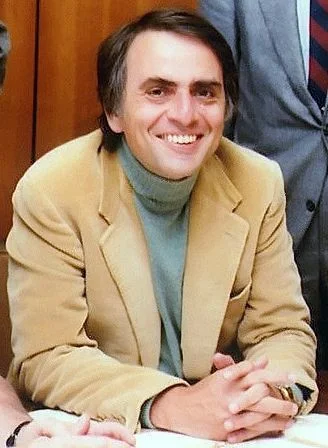
Pale Blue Dot" visionary: Sagan brought cosmos to Earth, inspired millions.
Conversation Starters
Life Journey
Carl Edward Sagan was born to a working-class Jewish family in Brooklyn. His mother was fiercely intellectual, and his father was a garment worker from Ukraine. The 1939 World's Fair in New York would spark his lifelong fascination with the future and the cosmos.
Young Carl visited the 1939 New York World's Fair with its 'World of Tomorrow' theme. The experience of seeing futuristic technology and the vision of space travel ignited an imagination that would never dim.
Sagan had an epiphany that transformed his worldview: the stars were suns, unimaginably far away, perhaps with their own planets. This realization launched his quest to understand humanity's place in the cosmos.
Sagan graduated from Rahway High School as an exceptional student with a burning passion for astronomy. He had already begun reading science fiction voraciously and dreaming of the planets.
Sagan earned both his BA in liberal arts and BS in physics from the University of Chicago. The intellectually rigorous environment shaped his commitment to skeptical inquiry and the scientific method.
Sagan completed his master's degree in physics at the University of Chicago, deepening his understanding of planetary science and laying the groundwork for his doctoral research.
Sagan earned his doctorate with a thesis on the physical properties of the Moon. His advisor was Gerard Kuiper, the father of modern planetary science. Sagan was now ready to explore the solar system.
Sagan joined Harvard University as an assistant professor and researcher at the Smithsonian Astrophysical Observatory. He began advising NASA on planetary missions that would soon transform our knowledge of the solar system.
After being denied tenure at Harvard, reportedly for being too famous, Sagan joined Cornell University. He would remain there for the rest of his career, building the Laboratory for Planetary Studies.
Sagan and Frank Drake designed the Pioneer plaque, humanity's first physical message sent beyond the solar system. The golden plate depicted human figures and Earth's location—a greeting card to the cosmos.
Sagan chaired the committee that created the Voyager Golden Record, a time capsule of sounds, images, and greetings from Earth sent into interstellar space. His third wife, Ann Druyan, helped select the contents. The record remains humanity's most profound message to the universe.
Sagan's television series 'Cosmos' premiered, becoming the most widely watched PBS series in history. His poetic explanations of science reached over 500 million people worldwide, making him the most famous scientist of his generation.
The companion book to the series became a bestseller, staying on The New York Times bestseller list for 70 weeks. Sagan's gift for explaining complex science in accessible, wonder-filled prose created millions of new science enthusiasts.
Sagan co-authored the influential 'TTAPS' paper warning that nuclear war could trigger a catastrophic 'nuclear winter.' His willingness to apply scientific analysis to existential threats demonstrated science's role in public policy.
Sagan married writer Ann Druyan, his creative partner on Cosmos and countless projects. Their love story began with a phone call where they realized they loved each other, and their partnership produced some of science communication's greatest achievements.
At Sagan's urging, Voyager 1 turned its camera back toward Earth from beyond Neptune, capturing the famous 'Pale Blue Dot' image. His reflection on this image became one of the most celebrated passages in science writing, reminding humanity of our fragile place in the vastness of space.
Sagan published 'Pale Blue Dot: A Vision of the Human Future in Space,' expanding his cosmic perspective into a meditation on humanity's destiny among the stars. The book inspired a new generation of space exploration advocates.
Carl Sagan died of pneumonia, a complication of myelodysplasia. He faced death with the same wonder and rationality he had brought to life, leaving behind an extraordinary legacy of science communication that continues to inspire millions to look up at the stars and ask profound questions about our place in the universe.