Quick Facts
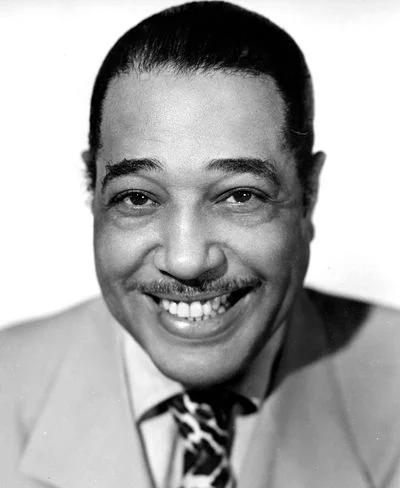
Take the A Train. Jazz royalty who composed American music for five decades.
Conversation Starters
Life Journey
Edward Kennedy Ellington was born into a middle-class African American family. His father was a butler who occasionally worked at the White House, instilling in young Edward a sense of elegance that would define his persona.
Ellington began piano lessons with a teacher named Mrs. Clinkscales. Though he initially resisted practice, preferring baseball, the instrument would become his voice for expressing the full range of human experience.
A childhood friend gave him the nickname 'Duke' for his aristocratic bearing and dapper dress. The name stuck permanently, perfectly capturing the regal elegance that would characterize both his music and personality.
Ellington began playing professionally at local dances and parties, often booking multiple bands under his name. He showed early talent not just for music but for organization and business—skills essential to his later success.
Ellington married his high school sweetheart Edna Thompson. Their son Mercer was born the following year. Though the marriage later failed, Mercer would become an important musician in his father's orchestra.
Ellington moved permanently to New York with his band, the Washingtonians. The move to Harlem placed him at the epicenter of African American cultural renaissance, where he would help define the sound of the Jazz Age.
Ellington's orchestra began a legendary residency at the Cotton Club in Harlem. The weekly radio broadcasts from this segregated venue paradoxically made him famous across racial lines throughout America.
Ellington released 'Mood Indigo,' one of his most famous compositions. The innovative use of muted brass created an unprecedented sonic texture that demonstrated his genius for orchestral color and atmosphere.
Ellington recorded 'Creole Rhapsody,' his first extended composition. Breaking the three-minute limit of standard records, it announced his ambition to elevate jazz beyond dance music into serious artistic expression.
Ellington made his first tour of Europe, where he was received as a serious composer rather than mere entertainer. The experience reinforced his determination to create music that transcended categories and challenged conventions.
Composer and arranger Billy Strayhorn joined Ellington's organization, beginning one of music's greatest creative partnerships. Strayhorn would write 'Take the A Train' and contribute to hundreds of Ellington compositions.
Ellington premiered his most ambitious work, 'Black, Brown and Beige,' at Carnegie Hall. This tone poem chronicling African American history demonstrated that jazz could address profound historical and social themes.
Ellington's orchestra electrified the Newport Jazz Festival with an extended performance of 'Diminuendo and Crescendo in Blue.' The concert revived his career and introduced his music to a new generation.
Ellington composed the score for Otto Preminger's film 'Anatomy of a Murder.' This was one of the first major Hollywood scores by a Black composer, expanding opportunities for African American artists in film.
Ellington premiered 'My People,' a musical celebrating African American history, during the centennial of the Emancipation Proclamation. The work expressed his deep commitment to Black culture and civil rights.
Ellington performed his First Sacred Concert at Grace Cathedral. These religious works, which he considered his most important music, expressed his lifelong spiritual faith in a uniquely jazz idiom.
President Nixon awarded Ellington the Presidential Medal of Freedom on his 70th birthday. The White House ceremony honored a lifetime of transforming American music and breaking racial barriers through art.
Duke Ellington died of lung cancer and pneumonia in New York City. Over 12,000 people attended his funeral at the Cathedral of St. John the Divine.