Chumi
BackChat
Eleanor of Aquitaine

Eleanor of Aquitaine

Queen of France

Start Chat

AI Personality

Quick Facts

Longest-reigning queen consort of the 12th century
Patron of the arts and literature
Active role in politics and governance

Life Journey

1122Born in Aquitaine, France

Eleanor was born to William X, Duke of Aquitaine, one of the wealthiest and most cultured princes in Europe. She was raised in a court renowned for troubadour poetry and received an education unusual for women of her time.

1137Became Duchess of Aquitaine

When her father died on pilgrimage to Santiago de Compostela, Eleanor became Duchess of Aquitaine, one of Europe's largest and richest duchies. She was suddenly the most eligible heiress in Europe.

1137Married Louis VII of France

Just weeks after her father's death, Eleanor married the young Louis VII of France. Their combined territories made them rulers of most of what is now France, but their personalities proved incompatible.

1147Joined Second Crusade

Eleanor accompanied Louis VII on the Second Crusade, one of the few queens to do so. Her presence caused scandal, particularly her close relationship with her uncle Raymond of Antioch, though no misconduct was proven.

1152Divorce from Louis VII

Eleanor's marriage to Louis VII was annulled on grounds of consanguinity, though their incompatibility and her failure to produce a male heir were the real reasons. She retained her vast Aquitaine inheritance.

1152Married Henry Plantagenet

Just eight weeks after her annulment, Eleanor married Henry, Duke of Normandy and future King of England. This union created the Angevin Empire, stretching from Scotland to the Pyrenees, and was a love match as well as political alliance.

1154Became Queen of England

When Henry became King Henry II of England, Eleanor became queen of the most powerful realm in Western Europe. She would bear Henry eight children, including future kings Richard I and John.

1167Established Court at Poitiers

Eleanor established her own court at Poitiers, which became a brilliant center of culture and courtly love. Troubadours, poets, and artists flourished under her patronage, and she helped develop the concept of chivalry.

1173Supported Sons' Rebellion

Eleanor supported her sons Henry, Richard, and Geoffrey in their rebellion against Henry II. When the revolt failed, she was captured while trying to flee to France disguised as a man.

1174Imprisoned by Henry II

Henry II kept Eleanor in comfortable but strict captivity for the next sixteen years. She was moved between various castles and rarely allowed public appearances, effectively removed from politics.

1189Released by Richard I

Upon Henry II's death, Eleanor's son Richard I immediately released her. At nearly seventy, she assumed a prominent role in his reign, acting as regent during his absence and mediating between her warring sons.

1190Served as Regent

While Richard was on the Third Crusade, Eleanor effectively ruled England and defended the realm against her youngest son John's intrigues. Her political acumen and energy were remarkable for a woman of her age.

1194Raised Richard's Ransom

When Richard was captured by Emperor Henry VI, Eleanor personally organized the collection of the enormous ransom of 150,000 marks. She traveled across England raising funds and later escorted Richard home.

1199Supported King John

After Richard's death, Eleanor supported John's claim to the throne against her grandson Arthur of Brittany. She personally held Anjou and Aquitaine for John and negotiated with Philip II of France.

1200Journey to Castile

At age 78, Eleanor made an arduous journey across the Pyrenees to Castile to choose among her granddaughters a bride for the French Dauphin. She selected Blanche of Castile, future mother of Saint Louis.

1202Defended Mirebeau

When besieged by her grandson Arthur's forces at Mirebeau, Eleanor held out until John arrived with a relieving army. This was the last major military action of her extraordinary life.

1204Died at Fontevraud Abbey

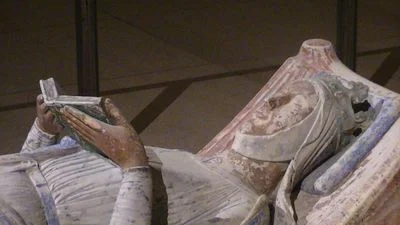
Eleanor died at Fontevraud Abbey, where she had retired as a nun. She was buried beside her husband Henry II and son Richard I. Her tomb effigy shows her reading, symbolizing her love of learning and culture.

Chat