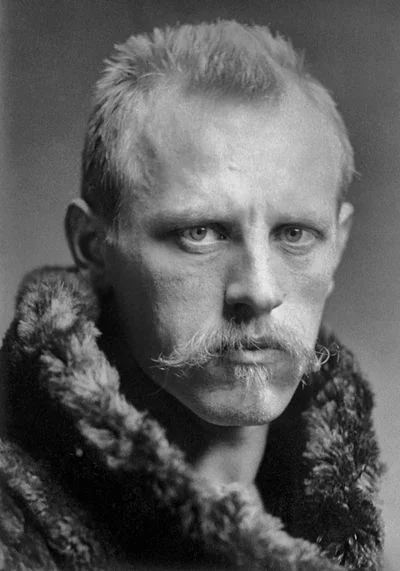
Quick Facts
Crossed Greenland, drifted toward the Pole, then saved millions as a humanitarian. Explorer-saint.
Conversation Starters
Life Journey
Fridtjof Nansen was born near Christiania (Oslo) into a lawyer's family. His childhood on a farm near the forest shaped his love of nature and skiing.
Nansen enrolled to study zoology at the Royal Frederick University. His scientific curiosity would drive both his academic and exploration careers.
Nansen joined the sealing vessel Viking on a voyage to Greenland waters. He made important zoological observations and became fascinated by Arctic exploration.
Nansen led a team that crossed the Greenland ice cap on skis, a feat previously thought impossible. This expedition made him an international celebrity.
Nansen completed his doctorate on the central nervous system of lower vertebrates. His research made significant contributions to neuroscience.
Nansen married Eva Sars, a singer and the daughter of a zoology professor. They would have five children together before her death in 1907.
Nansen departed on the specially designed ship Fram to test his theory that Arctic ice drifts from Siberia to Greenland. This three-year expedition would prove revolutionary.
Nansen and Hjalmar Johansen left the Fram and reached 86°14'N, the farthest north anyone had traveled. They survived an incredible overwintering on Franz Josef Land.
Nansen returned home to a hero's welcome. His expedition proved his drift theory and gathered invaluable scientific data on oceanography, meteorology and wildlife.
Nansen's two-volume account of his polar expedition became an international bestseller and inspired a generation of explorers including Amundsen and Shackleton.
Nansen served as Norway's first minister to Britain and played a crucial role in securing international recognition for Norway's independence from Sweden.
The University of Oslo created a professorship for Nansen in oceanography. He made pioneering contributions to understanding ocean currents and water masses.
Nansen was appointed High Commissioner for Refugees by the League of Nations. He would devote his remaining years to humanitarian work.
Nansen received the Nobel Peace Prize for his refugee work, including repatriating prisoners of war and creating the Nansen passport for stateless persons.
Nansen died of a heart attack on his veranda. He was mourned worldwide as a scientist, explorer and humanitarian who exemplified the ideals of human achievement.