Quick Facts
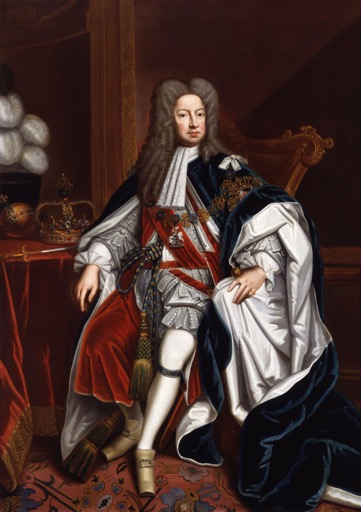
First Hanoverian monarch of Great Britain who spoke little English, establishing a Protestant succession that transformed British politics and created the modern cabinet government system.
Conversation Starters
Life Journey
George Louis was born as the eldest son of Ernest Augustus, Duke of Brunswick-Luneburg, and Sophia of the Palatinate. His mother's Stuart ancestry would eventually make him heir to the British throne through the Act of Settlement.
George embarked on a Grand Tour of Europe, visiting France and Italy to complete his princely education. He developed interests in music and Italian opera, patronizing composers like Handel throughout his life.
George married his cousin Sophia Dorothea of Celle in an arranged marriage to unite the Hanoverian territories. The marriage was unhappy from the start, though they had two children: the future George II and Sophia Dorothea of Hanover.
George joined the Imperial forces at the siege of Vienna during the Great Turkish War. He distinguished himself in battle and developed the military expertise that would serve him throughout his career.
After discovering Sophia Dorothea's affair with Count Konigsmarck (who mysteriously disappeared), George divorced her and had her imprisoned in Ahlden Castle for the rest of her life. She never saw her children again.
Upon his father's death, George became Elector of Hanover, one of the most important princes of the Holy Roman Empire. He now ruled a wealthy German state and commanded its military forces.
The English Parliament passed the Act of Settlement, ensuring Protestant succession by naming George's mother Sophia and her descendants as heirs to the English throne after Queen Anne. This bypassed over fifty Catholic claimants with stronger hereditary claims.
George served as a cavalry commander in the War of Spanish Succession, fighting alongside the Duke of Marlborough. His military experience enhanced his reputation and connections with British military leaders.
George's mother Sophia died just weeks before Queen Anne. When Anne died on August 1, 1714, George became King of Great Britain and Ireland, ending the Stuart dynasty and beginning the Hanoverian era.
George was crowned King George I at Westminster Abbey on October 20, 1714. His coronation was marked by Jacobite unrest, but the Protestant succession was secured. He spoke little English, conducting government business in French.
The Old Pretender James Stuart launched a rebellion to reclaim the throne. George's government decisively crushed the uprising at battles like Sheriffmuir and Preston, securing Hanoverian rule against Stuart restoration attempts.
George I's famous barge party on the Thames featured the premiere of Handel's Water Music. The king was so pleased he had the musicians play the suite three times. This cemented Handel's position as the leading composer in England.
A bitter quarrel erupted between George and his son, the future George II, over the christening of a grandchild. The prince was expelled from court, and father and son remained estranged, establishing a pattern of Hanoverian family discord.
Britain joined the Quadruple Alliance against Spain. The Royal Navy destroyed a Spanish fleet off Sicily, demonstrating Britain's growing naval power and George's commitment to European diplomacy.
The South Sea Company's stock collapsed catastrophically, ruining thousands of investors. Though George had invested in the scheme, his ministers managed the crisis. Robert Walpole emerged as the dominant minister, essentially becoming Britain's first Prime Minister.
Robert Walpole became First Lord of the Treasury and effectively the first Prime Minister, beginning 21 years of Whig dominance. George's limited English and preference for Hanover meant he delegated more power to his ministers than any previous monarch.
George signed the Treaty of Hanover, creating an alliance between Britain, France, and Prussia against Spain and Austria. His dual role as British King and Hanoverian Elector allowed him to play a complex diplomatic game in European politics.
George died of a stroke while traveling to his beloved Hanover. He was buried in the Leineschloss Church in Hanover, being the last British monarch not buried in England. His son succeeded him as George II.