Quick Facts
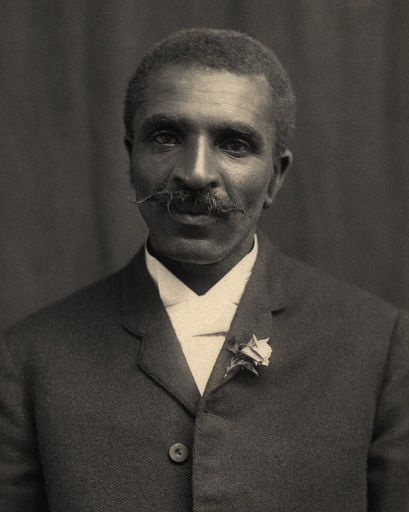
Pioneering agricultural scientist who advanced crop rotation, soil conservation, and practical innovations that empowered Southern farmers.
Conversation Starters
Life Journey
Born into slavery on the Moses Carver farm near Diamond Grove during the Civil War. Orphaned early and raised by Moses and Susan Carver, he was encouraged to read and explore plants despite harsh limits.
After emancipation, the Carver household kept raising him and his brother James as the region rebuilt. Susan Carver taught him basic literacy, and his fascination with gardens earned him the local nickname “the plant doctor.”
He left the Carver farm to seek formal schooling unavailable to Black children nearby. In Neosho he worked for room and board while attending classes, showing unusual discipline and a talent for drawing plants.
While in Fort Scott, he witnessed a brutal lynching that made the danger of the era unmistakable. He quickly left town, deciding to continue his education elsewhere rather than remain amid escalating racial terror.
He supported himself through farm labor and domestic work while living on the Kansas frontier. The experience sharpened his practical understanding of soils, crops, and rural poverty—problems he later tackled scientifically.
At Simpson College in Indianola, he pursued painting and piano, gaining supportive mentors in a rare integrated setting. His botanical drawings impressed faculty and helped steer him toward scientific study of plants.
He entered Iowa State, where horticulture and plant pathology training matched his interests. Professors including Joseph L. Budd and Louis H. Pammel encouraged his research skills and careful lab technique.
He completed a bachelor’s degree emphasizing horticulture and plant science at Iowa State. His reputation for meticulous greenhouse work and plant disease knowledge set him apart in a largely white institution.
He completed graduate study and became Iowa State’s first Black faculty member, teaching and conducting plant pathology research. His experiments focused on improving crop health, blending observation with careful trials.
Booker T. Washington personally invited him to lead agriculture at Tuskegee Institute as the South struggled with depleted cotton soils. Carver accepted, prioritizing service to poor farmers over more prestigious northern posts.
At Tuskegee he developed laboratories, field plots, and curricula that emphasized practical results over theory alone. He promoted composting, soil building, and diversified crops to reduce dependence on cotton in Alabama.
With support from philanthropist Morris K. Jesup, he helped create a traveling “school on wheels” to teach farmers directly. The wagon delivered demonstrations on crop rotation, fertilizers, and food preservation across rural communities.
He published accessible farm bulletins explaining how legumes restore nitrogen and improve worn-out fields. Recipes and processing tips connected science to household survival, making Tuskegee’s research useful to tenant farmers.
By the mid-1910s, his lectures and reports drew attention from educators and agricultural officials beyond Alabama. His focus on soil conservation and farmer education matched Progressive Era interest in scientific agriculture.
He spoke before the House Ways and Means Committee in Washington, D.C., explaining peanut production and its economic importance. His calm, practical testimony impressed lawmakers and newspapers, boosting his national fame.
The NAACP awarded him the Spingarn Medal, recognizing his scientific work and public benefit to Black Americans. The honor reflected how Tuskegee’s applied research became a symbol of intellectual excellence amid segregation.
As conservation became a national priority, he supported efforts aligned with the Soil Conservation Service’s goals. His long advocacy for crop rotation and organic matter in soils resonated as dust and erosion plagued farms.
He established a research foundation at Tuskegee to continue scientific work serving agriculture and industry. Carver directed proceeds and support toward student training and laboratory development rather than personal wealth.
He died after health declined following a fall and was buried near Booker T. Washington at Tuskegee Institute. His legacy endured through conservation farming, education outreach, and a model of service-driven scientific practice.