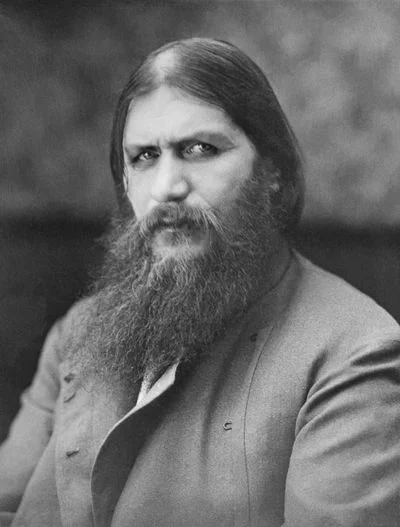
Quick Facts
Mad Monk who wouldn't die. Siberian mystic whose influence over the Tsarina helped doom Russia.
Conversation Starters
Life Journey
Grigori Yefimovich Rasputin was born to a peasant family in the remote Siberian village of Pokrovskoye. His early years were marked by poverty and the harsh conditions of rural Russian life.
Rasputin's older brother Dmitri drowned in a river accident. This traumatic loss deeply affected young Grigori and may have contributed to his later spiritual seeking.
Rasputin married Praskovya Fyodorovna Dubrovina, a fellow peasant from his village. They would have three children who survived to adulthood: Dmitri, Maria, and Varvara.
Rasputin left his family to become a strannik, a wandering holy pilgrim. He traveled to monasteries across Russia and reportedly even visited Mount Athos in Greece, developing his mystical beliefs.
Rasputin spent months at the Verkhoturye Monastery in the Ural Mountains. Here he deepened his religious practices and began developing his reputation as a holy man with healing powers.
Rasputin traveled to the imperial capital St. Petersburg for the first time. His reputation as a Siberian mystic and healer began to spread among the city's religious circles.
Rasputin was introduced to Tsar Nicholas II and Tsarina Alexandra through church connections. The royal couple, desperate for help with their hemophiliac son Alexei, were immediately drawn to him.
When young Alexei suffered a severe hemorrhaging episode, Rasputin appeared to stop the bleeding through prayer. This seemingly miraculous healing cemented his position with the imperial family.
Rasputin gained regular access to the imperial family. The Tsarina considered him a man of God and divine protector of her son, while critics began questioning his influence and behavior.
Facing accusations of sexual impropriety and membership in the Khlysty sect, Rasputin was investigated by church authorities. He was temporarily exiled to his home village to escape the scandal.
When Alexei nearly died from internal bleeding during a hunting trip, doctors gave up hope. Rasputin sent a telegram saying the boy would recover - and he did. His influence became unshakeable.
A woman named Khionia Guseva, follower of a rival monk, stabbed Rasputin in the stomach. He nearly died but recovered after surgery, viewing his survival as proof of divine protection.
As war loomed, Rasputin repeatedly warned the Tsar against entering the conflict, predicting it would bring disaster to Russia and the Romanov dynasty. His warnings went unheeded.
With Tsar Nicholas at the front, Tsarina Alexandra relied heavily on Rasputin's advice for government matters. He influenced ministerial appointments, creating outrage among the nobility.
Rasputin wrote a letter predicting that if he was killed by nobles, the Tsar's family would not survive two years. This chilling prophecy would prove remarkably accurate after the Revolution.
As Russia suffered military defeats and food shortages, Rasputin became the scapegoat for national misery. Rumors of his relationship with the Tsarina and German sympathies fueled public outrage.
On December 30, 1916, Prince Felix Yusupov and other nobles lured Rasputin to the Yusupov Palace. After poisoned cakes failed, he was shot multiple times and finally drowned in the Neva River.