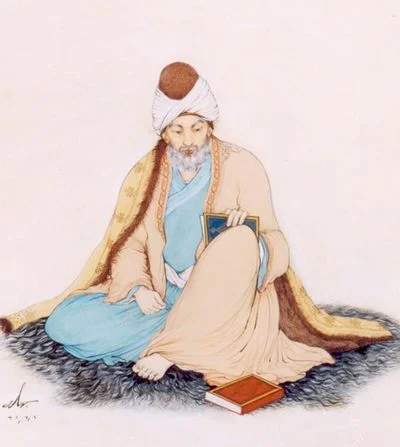
Quick Facts
Love is the bridge": Rumi, ecstatic Sufi poet, bridged worlds.
Conversation Starters
Life Journey
Jalal ad-Din Muhammad Rumi was born in the city of Balkh in the eastern part of Greater Khorasan (present-day Afghanistan). His father, Baha ud-Din Walad, was a renowned theologian and mystic. The region was a center of Islamic learning and Persian culture.
Amid growing political instability and the threat of Mongol invasion, Rumi's family departed Balkh, beginning a long westward journey. This migration would shape young Rumi's worldview as he encountered diverse cultures and spiritual traditions across the Islamic world.
During the family's journey through Nishapur, the young Rumi met the legendary Sufi poet Farid ud-Din Attar. According to tradition, Attar recognized Rumi's spiritual potential and presented him with a copy of his mystical work, the Asrar-nama (Book of Secrets).
The family undertook the hajj pilgrimage to Mecca, fulfilling one of Islam's five pillars. This sacred journey deepened young Rumi's religious devotion and exposed him to the diversity of the Muslim world gathered at Islam's holiest site.
Rumi studied Islamic jurisprudence and theology in Damascus, one of the great centers of learning in the medieval Islamic world. He was exposed to various schools of thought and began developing the intellectual foundations that would inform his later mystical teachings.
Rumi married Gowhar Khatun, daughter of a local notable. The marriage was arranged by his father. They would have two sons, Sultan Walad and Ala ud-Din, before her death. Sultan Walad would later become Rumi's biographer and successor.
At the invitation of the Seljuk Sultan Kayqubad I, Baha ud-Din Walad and his family settled permanently in Konya, the capital of the Seljuk Sultanate of Rum. Rumi's father became a prominent preacher and teacher at the royal court.
Upon his father's death, Rumi inherited his position as head of a madrasa (religious school). At only 24, he became responsible for teaching Islamic law and theology to students, continuing his father's legacy as a respected religious scholar.
Rumi began intensive spiritual training under Burhan ud-Din Muhaqqiq, a former student of his father. For nine years, he guided Rumi in the mystical path, deepening his understanding of Sufism and preparing him for his future role as a spiritual master.
By his mid-thirties, Rumi had become an established and respected Islamic jurist and theologian with thousands of students. He led a conventional life as a religious scholar, preaching and teaching traditional Islamic sciences, unaware of the transformation that awaited him.
On November 15, 1244, Rumi encountered the wandering dervish Shams-i-Tabrizi, a moment that would transform him forever. Their intense spiritual friendship sparked Rumi's poetic awakening, turning the respectable scholar into an ecstatic mystic poet who expressed divine love through verse.
Jealous students and family members, resentful of Rumi's exclusive devotion to Shams, drove the dervish away. Rumi was devastated by the separation. His son Sultan Walad eventually located Shams in Damascus and convinced him to return to Konya.
Shams mysteriously vanished forever, possibly murdered by jealous disciples. Rumi was consumed by grief, searching desperately for his beloved friend. This profound loss transformed into creative fire, inspiring thousands of verses in what would become the Divan-i-Shams-i-Tabrizi.
Rumi completed his monumental collection of lyric poetry, the Divan-i-Shams-i-Tabrizi, containing over 40,000 verses. Named for his spiritual companion, this work expressed the ecstasy and anguish of divine love through ghazals, quatrains, and other Persian poetic forms.
At the request of his disciple Husam ud-Din Chalabi, Rumi began dictating his greatest work, the Masnavi-i-Ma'navi (Spiritual Couplets). This epic poem of over 25,000 verses would become known as the 'Persian Quran' for its profound spiritual teachings told through stories and parables.
Rumi's teachings and practices crystallized into the foundations of the Mevlevi Order, famous for its whirling meditation ceremony (sema). The order formalized the spiritual path Rumi had pioneered, combining poetry, music, and dance as vehicles for divine communion.
After thirteen years of composition, Rumi approached the completion of his six-book Masnavi. The work wove together Quranic commentary, Sufi wisdom, folk tales, and Persian poetry into a tapestry of spiritual teaching that would influence mystics and poets for centuries.
Rumi died on December 17, 1273, a date commemorated annually by his followers as Shab-i-Arus (Wedding Night), celebrating his union with the Divine. His funeral was attended by mourners of all faiths. His tomb in Konya became a major pilgrimage site, and his poetry continues to inspire millions worldwide.