Kurzinfo
Glaube und Vernunft trafen sich: Aquin baute eine Bruecke zur goettlichen Wahrheit.
Gesprächseinstiege
Lebensweg
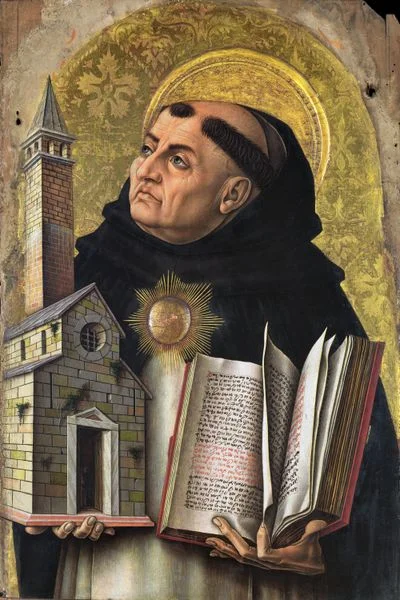
Thomas von Aquin wurde in die adlige Familie der Aquino auf Burg Roccasecca bei Neapel geboren. Sein Vater war Graf Landulf von Aquino, seine Mutter Theodora war normannischer Abstammung. Er war das jüngste von mehreren Kindern in diesem Adelshaus.
Mit fünf Jahren wurde Thomas als Oblate zur Benediktinerabtei Montecassino geschickt. Seine Familie hoffte, er würde dort Abt werden. Er erhielt seine frühe Ausbildung in Latein, Grammatik, Musik und religiösen Studien.
Nachdem Kaiser Friedrich II. die Mönche aus Montecassino vertrieben hatte, schrieb sich Thomas an der Universität Neapel ein. Er studierte die freien Künste und wurde durch seine Lehrer in die Philosophie des Aristoteles eingeführt.
Gegen den Willen seiner Familie trat Thomas dem Bettelorden der Dominikaner bei. Die Dominikaner waren ein neuer Orden, der sich der Predigt und Lehre widmete. Seine Familie war empört über diese Entscheidung.
Thomas' Brüder entführten ihn auf dem Weg nach Paris und sperrten ihn über ein Jahr im Familienschloss ein. Sie versuchten ihn davon abzubringen, den Dominikanern beizutreten, und schickten sogar eine Prostituierte, um ihn zu verführen. Thomas blieb standhaft.
Nach seiner Freilassung reiste Thomas nach Paris und dann nach Köln, um bei Albertus Magnus, dem führenden Dominikanergelehrten, zu studieren. Mitschüler nannten ihn wegen seiner Schweigsamkeit 'den stummen Ochsen', aber Albertus sagte seine Größe voraus.
Thomas wurde zum katholischen Priester geweiht und widmete sein Leben der Kirche. Er verband seine intellektuellen Bestrebungen mit seiner priesterlichen Berufung. Seine Predigten und sein Unterricht sollten legendär werden.
Thomas kehrte als Bakkalaureus an die Universität Paris zurück, um über Petrus Lombardus' Sentenzen zu lesen. Dies war der theologische Standardlehrplan. Er begann seine ersten Kommentare und Abhandlungen zu schreiben.
Thomas erhielt seinen Doktor der Theologie und wurde ordentlicher Magister an der Universität Paris. Trotz seiner Jugend und der Kontroverse zwischen Säkularen und Bettelorden erhielt er seinen Lehrstuhl neben Bonaventura.
Thomas kehrte nach Italien zurück, um als Generalprediger seines Ordens zu dienen und an verschiedenen Dominikanerschulen zu lehren. Er lehrte in Orvieto, Rom und Viterbo. Er begann seine großen theologischen Werke zu konzipieren.
Papst Urban IV. ernannte Thomas zum päpstlichen Theologen, eine Position großer Ehre und Verantwortung. Er komponierte auf Wunsch des Papstes die Liturgie für das Fronleichnamsfest.
Thomas vollendete die Summa contra Gentiles, ein philosophisches Werk zur Verteidigung des Christentums allein durch Vernunft. Es war als Handbuch für Missionare bei Muslimen und Juden gedacht. Es demonstrierte seine Beherrschung der aristotelischen Philosophie.
Thomas begann sein Hauptwerk zu schreiben, die Summa Theologica, eine umfassende systematische Theologie für Anfänger. Sie sollte der einflussreichste theologische Text im westlichen Christentum werden. Er arbeitete den Rest seines Lebens daran.
Thomas kehrte nach Paris zurück, um den Averroismus zu bekämpfen und die Vereinbarkeit von Glaube und Vernunft zu verteidigen. Er führte hitzige Debatten mit weltlichen Magistern. Seine polemischen Schriften aus dieser Zeit waren einflussreich.
Thomas wurde nach Neapel geschickt, um ein neues dominikanisches Studium generale zu gründen. Er schrieb weiter an der Summa Theologica, während er lehrte. Seine Gesundheit begann nach Jahren intensiver Arbeit nachzulassen.
Am 6. Dezember 1273 hatte Thomas während der Messe eine mystische Erfahrung, die ihn veränderte. Er hörte auf zu schreiben und sagte: 'Alles, was ich geschrieben habe, erscheint mir wie Stroh verglichen mit dem, was mir offenbart wurde.' Die Summa blieb unvollendet.
Papst Gregor X. rief Thomas zum Konzil von Lyon, um bei der Wiedervereinigung der Ost- und Westkirchen zu helfen. Thomas erkrankte auf der Reise und stieß mit dem Kopf gegen einen umgestürzten Baum.
Thomas starb am 7. März 1274 in der Zisterzienserabtei Fossanova. Er empfing die Letzte Ölung und soll gesagt haben: 'Ich empfange Dich, den Preis meiner Erlösung.' Er wurde 1323 heiliggesprochen und zum Kirchenlehrer erklärt.