Quick Facts
Eye for an eye. Babylonian king whose law code became civilization's first constitution.
Conversation Starters
Life Journey
Hammurabi was born into the royal family of the Amorite dynasty of Babylon. His father Sin-Muballit was the king of a small but strategically located city-state in central Mesopotamia.
The young prince received education in cuneiform writing, mathematics, astronomy, and Babylonian religious traditions. He studied the laws of earlier Mesopotamian rulers.
Upon his father's death, Hammurabi became the sixth king of the First Babylonian Dynasty. He inherited a small kingdom surrounded by more powerful rivals including Larsa, Eshnunna, and Assyria.
In his early reign, Hammurabi focused on internal improvements. He strengthened city walls, improved irrigation canals, and built temples to win the favor of the gods and his people.
Hammurabi married and established his household. His personal life was intertwined with religious duties, as the king served as the intermediary between gods and people.
Hammurabi skillfully navigated the complex political landscape of Mesopotamia, forming strategic alliances while preparing for eventual expansion. This diplomatic phase lasted nearly two decades.
Hammurabi undertook major construction projects including expanding the temple of Marduk, Babylon's patron deity. This elevated Babylon's religious significance in the region.
Breaking his former alliance, Hammurabi led his armies against Larsa. After a prolonged siege, he defeated Rim-Sin and absorbed the powerful southern kingdom into his growing empire.
Hammurabi's armies swept eastward, conquering Eshnunna and gaining control of vital trade routes. His military campaigns were characterized by strategic planning and overwhelming force.
Hammurabi defeated his former ally Zimri-Lim and captured the wealthy city of Mari. He later destroyed the city when it rebelled, demonstrating his ruthless approach to maintaining control.
Hammurabi's empire reached its greatest extent, stretching from the Persian Gulf to parts of Assyria. He controlled all of southern and central Mesopotamia, creating a unified Babylonian state.
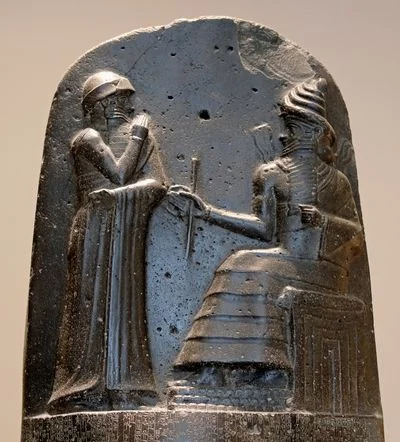
Hammurabi compiled and promulgated his famous law code, inscribed on a black diorite stele. The 282 laws covered family relations, property rights, trade, labor, and criminal justice with the famous principle of proportional punishment.
Hammurabi personally oversaw administration of his empire, as evidenced by thousands of clay tablets containing his correspondence. He managed water rights, temple affairs, and judicial matters directly.
In his final years, Hammurabi faced health challenges while continuing to manage his vast empire. The administrative burden of ruling such extensive territories took its toll.
Hammurabi prepared his son Samsu-iluna to inherit the throne. He ensured the continuity of his administrative systems and legal reforms, though the empire would face challenges after his death.
Hammurabi died after a 42-year reign that transformed Babylon from a minor city-state into the dominant power of Mesopotamia. His law code remains one of the oldest and most complete legal documents in human history.