Quick Facts
Iliad. Odyssey. Blind bard whose epics became Western civilization's foundation.
Conversation Starters
Life Journey
Homer is traditionally believed to have been born around 850-750 BCE, most likely in Ionia on the coast of Asia Minor. Ancient sources variously claim Smyrna, Chios, or other Ionian cities as his birthplace.
Like other poets of his era, young Homer would have been trained in the rich oral poetry tradition of ancient Greece, learning to compose and recite epic verses using formulaic phrases and hexameter rhythm.
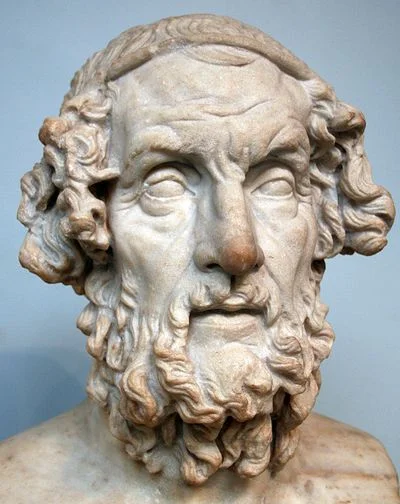
Ancient tradition holds that Homer was blind, though this may be symbolic rather than literal. The name Homer itself may derive from a word meaning hostage or blind, and blindness was associated with poetic inspiration.
Homer is thought to have traveled throughout the Greek world as an itinerant singer and poet, performing at festivals, courts, and public gatherings, earning his living through his performances of epic poetry.
Homer composed the Iliad, the oldest surviving work of Western literature. This epic poem of over 15,000 lines tells the story of the Trojan War, focusing on the wrath of Achilles and its devastating consequences.
Through his epics, Homer created enduring characters like Achilles, Hector, Odysseus, Helen, and Penelope. These figures have influenced Western literature, art, and culture for nearly three millennia.
Homer composed the Odyssey, the epic tale of Odysseus ten-year journey home from the Trojan War. This second great epic introduced themes of homecoming, identity, and the struggle against divine forces that continue to resonate today.
The Iliad and Odyssey became foundational texts in Greek education and culture. Students memorized passages, and the poems shaped Greek understanding of history, religion, morality, and heroism.
Homer or his followers performed his works at major pan-Hellenic festivals. These performances helped standardize the texts and spread Homeric poetry throughout the Greek-speaking world.
Homer established epic poetry as the highest form of literary art in ancient Greece. His works set the standard for narrative structure, character development, and poetic language that influenced all subsequent Western literature.
Homer is traditionally credited with the Homeric Hymns, a collection of poems praising various Greek gods. While scholars debate his authorship, these works extend the Homeric tradition of religious and mythological poetry.
Homers portrayal of the Olympian gods profoundly influenced Greek religious understanding. His anthropomorphic depictions of deities shaped how Greeks conceived of divine nature, behavior, and their relationship with mortals.
Even in ancient times, scholars debated the Homeric Question: whether one poet wrote both epics, their dates of composition, and what oral traditions preceded them. This debate continues among modern scholars.
Homer was recognized as the foundational poet of Western civilization. The Romans Virgil and later European writers saw him as the supreme model of literary excellence to be emulated but never surpassed.
According to ancient tradition, Homer died on the island of Ios in the Aegean Sea. His tomb became a site of pilgrimage, and the island claimed him as its most famous resident throughout antiquity.