Quick Facts
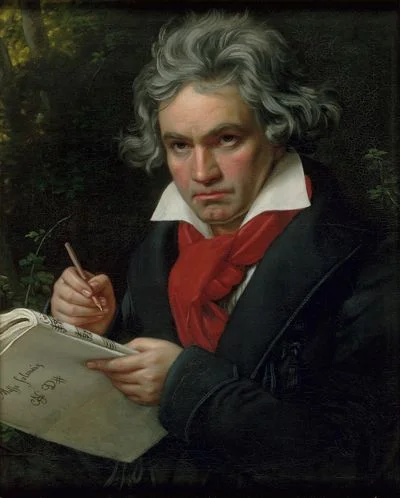
Ode to Joy" composer: deaf genius who redefined symphony, sonata.
Conversation Starters
Life Journey
Ludwig van Beethoven was baptized on December 17, 1770, in Bonn. His father Johann was a court musician who recognized Ludwig's talent and pushed him toward a musical career from childhood.
Beethoven gave his first public performance at age seven. His father, hoping to create another Mozart, advertised him as being younger. The performance marked the start of his public musical life.
Beethoven became a student of Christian Gottlob Neefe, the court organist. Neefe recognized his genius and introduced him to the works of Bach and contemporary composers.
At just twelve, Beethoven was appointed deputy court organist, beginning his professional career. He also published his first composition, a set of keyboard variations.
Beethoven traveled to Vienna and reportedly met Mozart, who said of him After hearing him play, mark that young man; he will make himself talked about in the world.
Beethoven moved to Vienna to study with Haydn. Vienna would become his permanent home, where he would compose most of his greatest works.
Beethoven made his public debut in Vienna, performing his Piano Concerto No. 2. He quickly established himself as the foremost pianist and rising composer in the city.
Beethoven's First Symphony premiered in Vienna. Though influenced by Haydn and Mozart, it showed hints of the revolutionary style that would define his later work.
Beethoven wrote the Heiligenstadt Testament, a letter revealing his despair over increasing deafness. He considered suicide but resolved to continue living for his art.
The Third Symphony premiered, originally dedicated to Napoleon. When Napoleon declared himself Emperor, Beethoven furiously scratched out the dedication. It revolutionized symphonic form.
Beethoven's only opera Fidelio premiered, though it was initially unsuccessful. He revised it multiple times, and it eventually became recognized as a masterpiece of humanist opera.
In a legendary four-hour concert, Beethoven premiered both the Fifth and Sixth Symphonies. The Fifth's opening motif became one of the most famous passages in all of music.
Beethoven wrote his famous letter to the Immortal Beloved, whose identity remains debated. This mysterious love letter reveals his capacity for deep romantic feeling despite his isolation.
Beethoven was celebrated at the Congress of Vienna, performing for assembled European royalty. He was at the height of his fame, though his hearing had almost completely failed.
Beethoven became legal guardian of his nephew Karl after his brother's death. The custody battle and troubled relationship with Karl caused him great anguish in his final years.
The Ninth Symphony premiered with its revolutionary choral finale. Completely deaf, Beethoven had to be turned around to see the thunderous applause he could not hear.
Beethoven composed his late string quartets, works so advanced they were not fully appreciated until the 20th century. They remain among the most profound works in classical music.
Beethoven died on March 26, 1827, during a thunderstorm. Legend says he shook his fist at the heavens. Over 20,000 people attended his funeral, honoring the revolutionary genius of music.