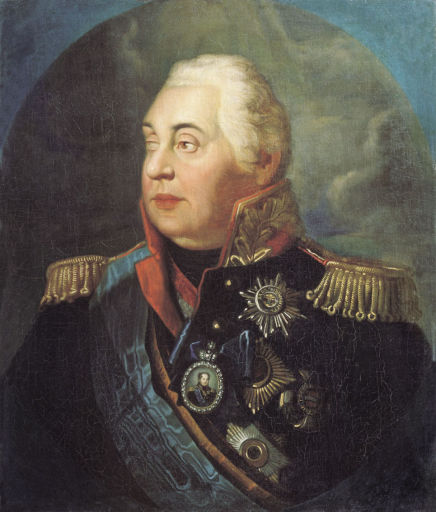
Quick Facts
Cunning Russian field marshal who outlasted Napoleon through strategic retreats, diplomacy, and ruthless endurance in 1812.
Conversation Starters
Life Journey
Born to Illarion Matveyevich Kutuzov, an army engineer officer, in the imperial capital. He grew up in a courtly-military milieu where service to the state shaped education and ambition.
Admitted to the Artillery and Engineering Noble Cadet Corps, Russia’s elite technical academy for officers. He studied fortifications, mathematics, and languages, preparing for both command and staff work.
Commissioned into the army and assigned to units shaped by reforms under Catherine II’s early reign. His early postings exposed him to drill, logistics, and the politics of patronage within the officer corps.
Joined campaigns in the Polish-Lithuanian Commonwealth, where Russian influence was contested by confederate forces. Service under Alexander Suvorov sharpened his appreciation for speed, deception, and morale.
Deployed to the southern front as war erupted with the Ottoman Empire over Black Sea power and Balkan influence. He learned siegecraft and combined-arms operations amid brutal steppe campaigning and disease.
During operations in Crimea, he suffered a grave head wound that damaged his eye, nearly ending his career. The injury became part of his public image as a scarred veteran of imperial expansion.
Granted leave to recover and travel, he observed European military practice and court diplomacy firsthand. Exposure to Prussian and Austrian methods broadened his sense of how war and statecraft intertwined.
Re-entered frontline service as Russia consolidated new territories along the Black Sea. He worked with administrators and engineers to secure ports and supply lines vital to Catherine II’s southern strategy.
With war renewed, he fought in major operations aimed at breaking Ottoman control of key fortresses. His command experience expanded in a conflict that tested coordination between army, navy, and allies.
During the costly siege of Ochakov, he received another serious wound while directing troops in close combat. The campaign’s winter hardships reinforced his later belief that endurance and time can defeat brilliance.
Serving in the Danube theater, he participated in the struggle for Ottoman strongholds that controlled river crossings and trade. Work alongside Suvorov’s circle deepened his skill in planning assaults and reserves.
In the turbulent years of Poland’s partitions, he held commands amid uprisings and shifting borders shaped by Russia, Prussia, and Austria. The experience trained him in occupation duties and political restraint.
Named ambassador to the Sublime Porte, he negotiated amid rivalry over the Black Sea and Balkan clients. His ability to read court factions in Constantinople strengthened his reputation as soldier-statesman.
Placed in charge of Russian troops allied with Austria against Napoleon, he cautioned against rash battle under political pressure. At Austerlitz, the coalition suffered a decisive defeat that haunted Russian strategy.
After the disaster, court politics and rivalry among commanders reduced his influence at St. Petersburg. He spent years in secondary posts, watching Alexander I navigate between war, reform, and alliances.
Given command on the Danube, he sought a quick settlement to free Russia for the looming conflict with France. His campaign helped push the Ottomans toward the Treaty of Bucharest, securing Bessarabia.
With the Grande Armée deep in Russia and public anger rising, Alexander I appointed him to unify Russian command. He balanced nobles, generals, and the Orthodox public while prioritizing preservation of the army.
He chose to stand near Borodino outside Moscow, where massed artillery and entrenched positions produced immense casualties. Though tactically inconclusive, the battle exhausted Napoleon’s forces and bought strategic time.
At the council in Fili, he accepted the politically explosive decision to abandon Moscow to save the army. The withdrawal and subsequent fires denied Napoleon supplies, turning occupation into a logistical trap.
He coordinated harassment of retreating French columns with regular troops, Cossacks, and partisan bands across devastated roads. Battles near Maloyaroslavets and along the Berezina crossings accelerated the collapse.
As Russian armies advanced into German lands to continue the coalition war, his health failed after months of strain. He died in service, leaving Alexander I and successors to finish the struggle against Napoleon.