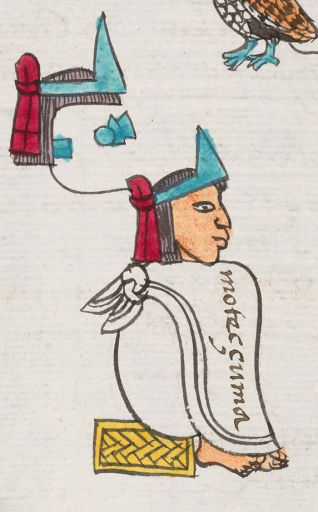
Quick Facts
An embattled Aztec emperor whose diplomacy, ritual authority, and crisis leadership collided with the Spanish conquest.
Conversation Starters
Life Journey
Born into the ruling dynasty of the Mexica in the Basin of Mexico, he grew up amid court ritual and warrior training. Chroniclers later linked his childhood to the political world of the Triple Alliance centered on Tenochtitlan.
As a youth he was educated in elite schools where nobles learned sacred calendars, oratory, and martial discipline. This dual preparation strengthened his legitimacy in a society where war, tribute, and ritual reinforced imperial power.
During the reign of Ahuitzotl, Tenochtitlan staged grand temple rites that displayed the empire’s reach and wealth. These events tied provincial tribute to the capital’s religious spectacle and shaped Moctezuma’s sense of imperial theater.
He advanced within the ruling elite, gaining experience in administration, diplomacy, and the management of tribute flows. Serving close to the throne exposed him to factional politics among powerful lineages and military orders.
Mexica forces campaigned against resistant provinces to reaffirm tributary duties and secure captives for state rituals. Participation in these wars built his reputation as a disciplined commander within the empire’s expansionist system.
After Ahuitzotl died, nobles and leading warriors selected Moctezuma as Huey Tlatoani, emphasizing pedigree and proven competence. His enthronement affirmed the Triple Alliance order linking Tenochtitlan with Texcoco and Tlacopan.
He reinforced strict etiquette at court, separating commoners from noble space and amplifying sacred kingship. The capital’s ceremonies, gifts, and processions projected control over distant provinces through awe and carefully managed access.
Moctezuma strengthened tribute collection by supervising officials who recorded deliveries of cacao, cotton, and feathers from subject regions. These flows financed temples, armies, and noble households, binding provincial elites to imperial expectations.
Several regions resisted Mexica demands, forcing political negotiation backed by military threat. He relied on intimidation, hostages, and strategic appointments of local rulers to keep the tribute network functioning.
Coastal scouts reported Spanish expeditions along the Gulf, describing unfamiliar weapons, animals, and ships. The court gathered intelligence through messengers and merchants, weighing omens and political risks in a volatile imperial landscape.
Moctezuma sent envoys bearing rich textiles and goldwork to evaluate the newcomers and discourage advance. These exchanges, recorded in Spanish chronicles and Indigenous accounts, became an early battleground of misunderstanding and strategy.
Cortes forged alliances with Totonac and especially Tlaxcalan forces, turning regional rivalries against Mexica dominance. Moctezuma faced a coalition threat that combined Spanish arms with local knowledge and long-held grievances.
In November, he received Cortes in the island capital with elaborate hospitality meant to assert status and control. The encounter placed diplomacy at the center of an unfolding invasion, observed by nobles, priests, and Spanish soldiers.
Cortes seized Moctezuma within his own city, using him as a hostage to issue orders and calm unrest. The emperor’s authority became contested as Spaniards demanded gold and sought to reshape political control through coercion.
While Cortes was absent, Pedro de Alvarado ordered an attack during a major ceremony, triggering fury across Tenochtitlan. The violence shattered fragile coexistence and sparked open warfare between Mexica defenders and Spanish occupiers.
During the uprising, Moctezuma was fatally wounded amid chaos as Spaniards tried to use him to pacify the city. Accounts differ on whether stones from angry crowds or Spanish actions caused his death, reflecting deep contestation of memory.
Soon after, Cortes and his allies attempted a nighttime escape across causeways, suffering heavy losses in fighting and drowning. The retreat marked a turning point that foreshadowed a longer siege and the eventual fall of the city-state.