Quick Facts
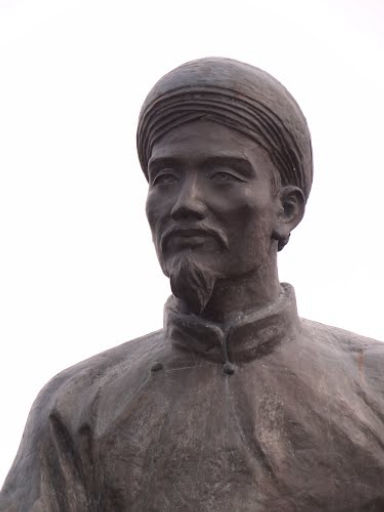
A compassionate Vietnamese poet-diplomat who transformed personal exile and political upheaval into enduring literary brilliance.
Conversation Starters
Life Journey
Born to Nguyễn Nghiễm, a high-ranking official, and Trần Thị Tần in a powerful literati household. Growing up amid Confucian education and court politics shaped his early mastery of classical learning and verse.
After losing key family protectors during his youth, he experienced insecurity despite noble status. The Trịnh–Nguyễn conflicts and worsening instability around Thăng Long deepened his sensitivity to human misfortune.
He pursued the Confucian examination path expected of a mandarin’s son, refining Chinese-classical prose and regulated verse. Early contacts with scholar-official networks later helped him navigate rapid regime change.
The Tây Sơn movement swept north and shattered the old political order, overturning long-standing Trịnh dominance. Nguyễn Du’s world of courtly stability collapsed, sharpening themes of fate, loss, and displacement in his writing.
As competing factions fought for control, his relatives and patrons were dispersed, and careers were abruptly derailed. He endured precarious living conditions, later recalling these years as formative in understanding suffering beyond elites.
He lived away from power centers, often described as a period of wandering and constrained means. Close contact with villagers and common hardships broadened his emotional range and enriched the social realism of his later poetry.
Settling for stretches in his ancestral region, he immersed himself in reading, composing, and reflecting on the ruined Lê world. These quiet years helped crystallize his voice: lyrical compassion paired with moral ambiguity and irony.
After Nguyễn Ánh became Emperor Gia Long and reunified Vietnam, Nguyễn Du accepted appointment as a mandarin. The choice carried personal tension for a former Lê-affiliated family, feeding his enduring concern with loyalty and fate.
He served in provincial governance, handling documents, taxation matters, and local disputes within the Nguyễn bureaucracy. Daily exposure to injustice and vulnerability among ordinary people reinforced his poetic focus on compassion and moral limits.
Recognized for literary talent and administrative reliability, he moved upward in the mandarin hierarchy. Court culture in Phú Xuân (Huế) offered access to archives and intellectual circles, but also constant political scrutiny.
He traveled as a Nguyễn envoy through major Chinese routes, meeting officials and observing Qing institutions firsthand. The journey broadened his cultural reference points and inspired poems reflecting on empire, history, and personal solitude.
During and after the embassy trip, he wrote verses that juxtaposed famous landscapes with inner melancholy and ethical doubt. Encounters with Chinese literary sites and officials strengthened his ability to fuse classical allusion with lived pain.
In mature years he shaped the Vietnamese Nôm masterpiece widely known as The Tale of Kieu, reworking earlier narrative material into extraordinary lục bát verse. Its psychological depth and empathy for women made it culturally foundational.
After Gia Long’s death, Emperor Minh Mạng reorganized court priorities and external relations, drawing on experienced envoys. Nguyễn Du was selected again for high-stakes diplomacy, reflecting trust in his learning and composure.
He fell ill and died as preparations were underway for another embassy to the Qing court. His death ended a life marked by upheaval and service, yet his poetry endured as Vietnam’s most intimate moral mirror.
Courtiers, scholars, and later generations preserved and recited his works, especially The Tale of Kieu, as a national literary touchstone. His blend of Confucian ethics and compassion helped define Vietnamese cultural memory in print and song.