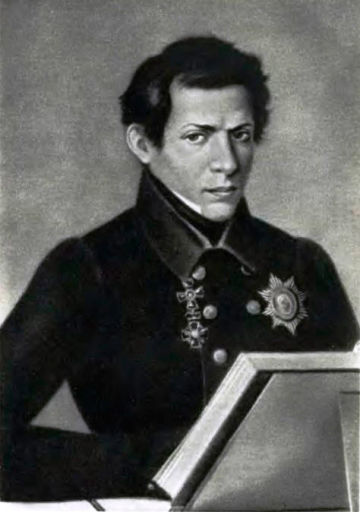
Quick Facts
Pioneered non-Euclidean geometry, challenging centuries of mathematical certainty while leading a major Russian university through reform.
Conversation Starters
Life Journey
Born in the provincial city of Nizhny Novgorod in the Russian Empire, he entered a world shaped by Enlightenment science and imperial bureaucracy. His early years were marked by limited means, sharpening a practical determination to advance through education.
After his father Ivan Lobachevsky died, the family faced financial strain and sought stability through schooling opportunities. The relocation toward Kazan placed him near a growing intellectual center supported by the Russian state’s educational reforms.
He enrolled at the Kazan Gymnasium, where mathematics and languages were taught to prepare students for imperial service. Teachers noted his intensity and talent, and he gravitated toward geometry and logical argument over rote memorization.
He entered Kazan University soon after its establishment as a modern institution on the Volga frontier. The university imported European scholarship and textbooks, giving him access to contemporary debates on Euclid, calculus, and scientific method.
He studied and worked closely with Johann Christian Martin Bartels, a German mathematician and former teacher of Carl Friedrich Gauss. Bartels encouraged exact proof and broad reading, habits that later helped Lobachevsky question the parallel postulate.
He received an early appointment to teach mathematics, reflecting both his ability and the university’s urgent need for staff. While lecturing on geometry and analysis, he began privately exploring whether Euclid’s axioms were uniquely necessary.
He advanced to a professorship, gaining greater freedom to shape curricula and examinations at Kazan University. This position let him refine his logical approach to geometry and test ideas against students’ questions and classical proofs.
He accepted responsibilities that went beyond research, helping oversee teaching standards and institutional discipline. The balancing act between governance and scholarship later became central as he tried to publish controversial geometric ideas in an uneasy climate.
He delivered a lecture outlining a geometry where multiple lines through a point can be parallel to a given line. The claim challenged centuries of Euclidean authority, and he framed it as a logically consistent alternative rather than a paradox.
He became rector, placing him at the helm of one of Russia’s key regional universities during a politically cautious era after the Decembrist revolt. He pushed for improved laboratories, teaching quality, and library holdings while protecting scholarly work from pressure.
During the 1830 cholera epidemic, he organized measures to keep the university functioning while reducing contagion risks. The crisis demanded logistical discipline and public trust, reinforcing his reputation as a steady administrator as well as a mathematician.
He issued influential work describing a consistent geometry that rejected Euclid’s parallel postulate and developed new trigonometric relations for it. Because Russian and European audiences were skeptical, these publications circulated slowly despite their originality.
He broadened his mathematical output, combining geometric intuition with analytic calculation to make his new theory more usable. By connecting abstract axioms to computable results, he aimed to show that the alternative geometry was not mere wordplay.
He released his most famous exposition, 'Geometrical Researches on the Theory of Parallels,' summarizing decades of thought. Printed in Russian and later reaching wider readers, it argued that geometry’s axioms are hypotheses tested by logical consistency and application.
After long service, he was forced out of the rector’s office as bureaucratic tensions and internal criticism mounted. The loss reduced his institutional influence and income, showing how fragile academic freedom could be within imperial administrative structures.
In later years he suffered worsening health, including declining eyesight, while managing family responsibilities on reduced means. Despite these hardships, he continued to write and correspond, trying to secure recognition for his geometric revolution.
As mathematicians in Europe reconsidered foundations, his earlier ideas started to seem less heretical and more visionary. He worked on late manuscripts and revisions, hoping his approach would be judged by logical strength rather than tradition.
He died in Kazan, leaving behind a body of work that later transformed geometry and influenced mathematical physics. Though recognition came slowly, his insistence on consistent alternatives to Euclid reshaped how modern mathematics understands space.