Quick Facts
A reformist Lao monarch who defended Theravada Buddhism and relocated his capital to Vientiane amid regional wars.
Conversation Starters
Life Journey
Born as Prince Setthathirath to King Photisarath of Lan Xang, he grew up amid shifting alliances among Lan Xang, Lanna, and Ayutthaya. Court tutors in Luang Prabang trained him in Theravada Buddhist kingship and diplomacy.
As regional rivalries intensified, the young prince was drawn into Lanna politics centered on Chiang Mai and Chiang Saen. His presence helped Photisarath project influence beyond the Mekong while learning northern administration and warfare.
Following a contested succession in Lanna, Setthathirath was elevated by factions seeking stability against external threats. His position in Chiang Mai placed him at the crossroads of Toungoo pressure and Ayutthaya ambitions in the north.
News of King Photisarath’s death forced Setthathirath to leave Lanna to secure the Lan Xang succession. The journey back was politically risky, as nobles weighed rival claimants and neighbors watched for a power vacuum along the Mekong.
Setthathirath took the Lan Xang throne in Luang Prabang with the support of leading court lineages and Buddhist clergy. His early rule focused on consolidating authority, disciplining provincial governors, and preparing for looming Toungoo expansion.
To strengthen legitimacy, he arranged the transfer of the revered Emerald Buddha from Lanna to Lan Xang. The relocation linked royal power to sacred authority and signaled a shift of religious prestige toward the Lao court.
Anticipating war, he reinforced defenses around strategic river routes connecting Luang Prabang to the central plains. Local levies and nobles were reorganized to secure supply lines and slow enemy columns moving from the west and north.
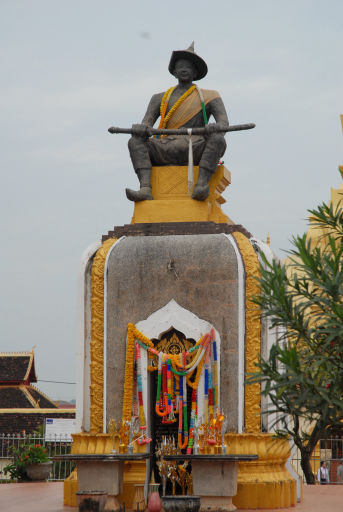
Setthathirath shifted the royal seat to Vientiane to better control the Mekong corridor and respond to threats from Burma and Siam. The move reshaped administration, drew craftsmen and monks southward, and made the city a political center.
He sponsored rebuilding and expansion of the great stupa later known as Pha That Luang, aligning monarchy with Buddhist merit-making. Monastic communities and artisans in Vientiane benefited from royal patronage and labor mobilization.
As King Bayinnaung’s Toungoo Empire expanded, Burmese commanders probed Lan Xang’s borders through Lanna and the Shan region. Setthathirath reinforced outposts and prepared scorched-earth measures to deny invaders food and transport.
Rather than fight set-piece battles, he relied on ambushes, rapid raids, and withdrawal into difficult terrain. Local leaders coordinated with the court to harass Burmese supply trains and protect Buddhist sites and population centers.
After the Toungoo capture of Ayutthaya, Burmese attention intensified on Lan Xang as the next target. Setthathirath avoided decisive encirclement by abandoning exposed positions and pulling forces into the interior around Vientiane and beyond.
To blunt occupation, he directed communities to relocate temporarily with rice stores and livestock, leaving little for enemy garrisons. This policy strained civilians but undermined Burmese attempts to hold territory and extract sustained tribute.
Facing superior numbers, he used envoys and ritual diplomacy to divide opponents and delay renewed campaigns. Messages moved along Mekong routes to neighboring courts, balancing resistance with pragmatic bargaining to preserve Lan Xang autonomy.
Late in his reign, Setthathirath vanished during a period of factional conflict and frontier pressure, with chronicles giving conflicting accounts. His absence destabilized succession politics and opened space for competing nobles to assert control.
After Setthathirath’s disappearance, rival claimants and court factions contested authority in Vientiane and Luang Prabang. The turmoil made coordinated defense harder and left Lan Xang more vulnerable to Burmese intervention and internal coups.