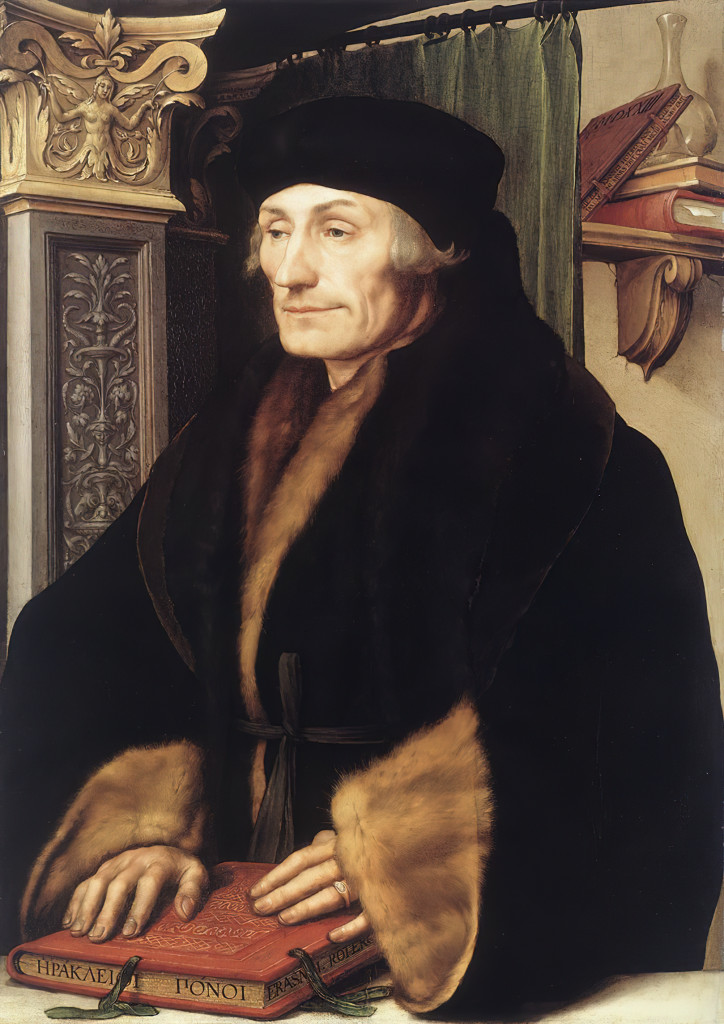
Quick Facts
The Renaissance humanist and Catholic priest who shaped Reformation-era scholarship through influential writings and critical editions of Christian texts.
Conversation Starters
Life Journey
Desiderius Erasmus was born in Rotterdam, traditionally dated 1466, to a priest and a physician’s daughter. His ambiguous status shaped a lifelong drive for learning, patronage, and social mobility.
As a boy he received Latin schooling typical for ambitious clerical careers in the Burgundian Netherlands. The region’s urban literacy and church institutions offered pathways for gifted students like him.
Erasmus lost his parents during a period of recurrent plague in the Low Countries. Guardians pressed him toward the religious life, narrowing options yet keeping education within reach.
He joined the Augustinian community at Steyn, absorbing devotional reform currents and extensive Latin reading. Monastic discipline also spurred his later critique of empty ritual and clerical complacency.
Leaving Steyn’s routine, he served Henry of Bergen, Bishop of Cambrai, gaining contacts and access to patrons. The post positioned him within ecclesiastical administration while he pursued humanist study.
Erasmus was ordained a priest, a status that secured income and legitimacy in a church-dominated society. He nonetheless sought dispensations and mobility to prioritize scholarship over pastoral routine.
At Paris he encountered scholastic theology and the harsh economics of student life. The experience sharpened his preference for classical philology and ethical Christianity over technical disputation.
Traveling to England, he met John Colet and Thomas More, forging friendships central to northern humanism. Their reform-minded classicism reinforced his program of returning to Scripture and the Fathers.
He issued the first version of the Adagia, a collection of classical proverbs with learned commentary. Its rapid expansion and popularity made him a European literary figure and a model of humanist style.
Erasmus took a theology doctorate, credentialing his authority in religious debate. The degree helped him speak as an insider reformer rather than an outsider critic of the church.
While staying with Thomas More, he composed In Praise of Folly, a witty satire of superstition and clerical abuses. Its humor carried sharp moral critique, spreading his reformist message widely.
He held a position at Cambridge, helping promote Greek studies crucial to biblical humanism. The appointment linked English scholarship to continental networks and supported his philological projects.
The Enchiridion urged inward piety, moral discipline, and Scripture-centered devotion over mere ceremonies. It became a cornerstone of Christian humanism and influenced reform-minded readers across Europe.
He deepened collaboration with Basel’s leading printer Johann Froben, benefiting from the era’s print revolution. Access to manuscripts and presses accelerated his plan for a new Greek New Testament.
Erasmus issued the first published Greek New Testament with a revised Latin translation and notes. Though imperfect, it transformed scholarly tools and later shaped Reformation-era Bible translations and debates.
As controversy rose around church reform, Erasmus’s calls for moderation and learning drew admirers and critics. His position between old church structures and new reform movements made him influential and embattled.
With Luther’s challenge spreading, many demanded Erasmus declare allegiance to one side. He resisted polarization, arguing that scholarship and moral reform should not collapse into factional warfare.
He frequently complained of frail health, likely aggravated by travel, diet, and constant writing. Physical weakness did not halt his output, but it shaped his desire for stability and careful pace.
In De libero arbitrio he defended a cooperative view of human freedom within divine grace. The treatise triggered a major theological exchange, defining him as a moderate Catholic critic of extremes.
As Basel adopted reform, Erasmus relocated to Freiburg to avoid religious turmoil and protect his independence. The move signaled how confessional politics increasingly constrained scholars’ choices.
He continued revising his New Testament text and annotations, aiming for greater philological accuracy. These editions remained foundational for later textual traditions, including the emerging Textus Receptus.
Erasmus worked to maintain friendships across Catholic and reform-leaning circles as hostility hardened. Patronage and correspondence sustained his scholarship when ideological camps demanded conformity.
He returned to Basel, again close to Froben’s press and the city’s intellectual infrastructure. Managing editions and correspondence, he focused on shaping how his works would be read after his death.
Erasmus died in Basel in 1536, as Europe fractured into confessional blocs. His critical scholarship and Christian humanism endured, influencing Catholic reformers and Protestant intellectual culture alike.