Kurzinfo
A bold retainer who seized a diplomatic moment, turning sharp words and fearless poise into decisive political leverage.
Gesprächseinstiege
Lebensweg
Qin’s victory at Changping devastated Zhao’s manpower and emboldened Qin diplomacy and siege warfare. In Handan, Zhao elites rallied around influential nobles like Lord Pingyuan to seek allies against Qin’s pressure.
Mao Sui served in the entourage of Lord Pingyuan (Pingyuan Jun), a leading Zhao noble known for hosting talented men. Despite ambition, he remained unnoticed among many guests competing for patronage in Handan’s crowded court circles.
Within the Pingyuan household, Mao Sui observed debates on alliances, tribute, and military logistics. He trained himself to speak with precision, learning how Warring States envoys used precedent and veiled threats to move kings.
As Qin tightened its grip on northern states, Zhao’s leaders feared encirclement and siege. Lord Pingyuan prepared to seek aid abroad, knowing that words in a distant palace could decide whether Handan survived another campaign.
When Lord Pingyuan struggled to select enough capable attendants for a high-stakes embassy to Chu, Mao Sui stepped forward uninvited. His sudden self-recommendation challenged hierarchy, forcing Pingyuan to judge talent beyond reputation.
Mao Sui argued that a blade kept in its sheath cannot prove its sharpness, pressing Pingyuan to test him in real danger. The exchange exposed how patronage networks could miss capable men, especially those without celebrated introductions.
The embassy journey linked Zhao’s northern court to Chu’s southern power centers, passing through contested regions shaped by recent wars. Mao Sui watched senior envoys rehearse wording, aware that a single misstep could end negotiations.
In Chu’s palace, Lord Pingyuan’s formal arguments failed to secure a firm commitment, as Chu hesitated to risk Qin’s retaliation. The prolonged audience revealed how kings weighed distant promises against immediate strategic threats.
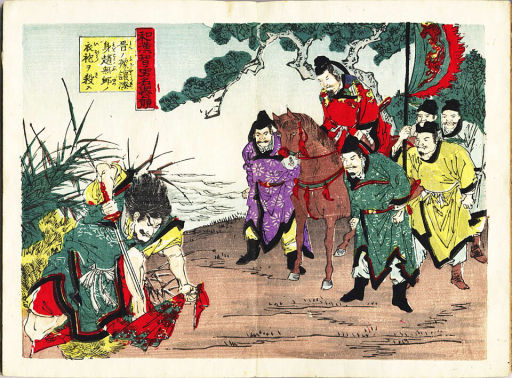
Breaking protocol, Mao Sui advanced from the attendants’ line and asked to address King Kaolie himself. His boldness shocked the court, but it created a decisive moment, shifting the audience from rehearsed ceremony to urgent reality.
Mao Sui pressed that Chu’s security was tied to resisting Qin, warning that appeasement would invite future invasion. Classical accounts describe him speaking with steely confidence—so intense it felt like a weapon drawn in the throne hall.
King Kaolie accepted the logic that aiding Zhao could check Qin’s expansion and preserve Chu’s strategic depth. The commitment strengthened Zhao’s diplomatic position, showing how a single envoy’s timing and language could redirect state policy.
Back in Handan, the embassy’s success elevated Mao Sui from anonymity to a household name within Pingyuan’s circle. His story spread among retainers and officials as proof that talent could surface suddenly under extreme pressure.
Court commentators cited Mao Sui when urging nobles to keep open channels for overlooked talent. In the competitive Warring States environment, his example helped justify pragmatic promotion based on results rather than pedigree alone.
Later compilers, including Sima Qian’s tradition in the Han era, preserved the tale as a moral about self-advocacy and readiness. The phrase became shorthand for stepping forward at the critical moment, especially when others hesitate.
As Qin continued to pressure the eastern states, diplomats and strategists retold Mao Sui’s feat to emphasize urgency and unity. The narrative endured because it matched the era’s stakes: survival depended on bold speech and timely coalition-building.
Although biographical details of his later life remain scarce, Mao Sui’s reputation persisted through didactic histories and anthologies. He is remembered less for office held than for one pivotal audience where courage and rhetoric changed outcomes.