Informações rápidas
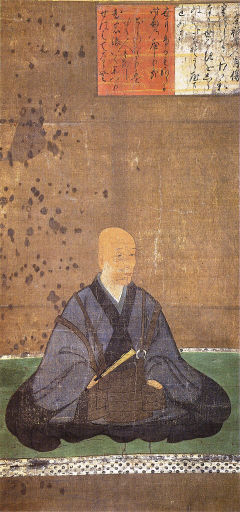
A wandering Zen-linked renga master who refined collaborative verse into an elegant, widely admired literary art.
Iniciadores de conversa
Jornada de vida
Born in Japan during the politically fragmented Muromachi era, when court culture and warrior power overlapped. Later sources suggest humble origins, shaping his lifelong plain manner despite elite literary acclaim.
As a youth he trained in Buddhist institutions connected to Zen, learning disciplined reading, calligraphy, and classical poetry. Temple networks also introduced him to renga gatherings where linked verse was becoming fashionable among elites.
He began traveling widely as an itinerant cleric and poet, moving between temples and patron households. This mobility let him build a national circle of students and collaborators while refining a precise, restrained poetic style.
By midlife he was sought out for leadership in renga sessions, valued for both taste and rule-knowledge. His ability to guide multiple voices into a single elegant sequence made him a model for professional linked-verse masters.
When the Onin War erupted and Kyoto burned, he continued poetic work through displacement and scarcity. Renga meetings offered patrons a fragile continuity of culture, and his calm leadership became especially valued in wartime society.
He cultivated support from influential monks and warrior administrators who sponsored renga as a mark of refinement. These relationships funded travel and copying of texts, and they spread his standards beyond courtly Kyoto circles.
Through teaching notes and critical guidance, he emphasized balance, seasonal sensitivity, and controlled allusion in renga. His approach treated the sequence as a living conversation, where each link both answers and redirects the prior verse.
He presided over major gatherings where nobles, monks, and warriors collaborated under strict linking rules. His presence elevated events into cultural landmarks, and participants recorded sequences as proof of taste and social standing.
Students sought him not only for technique but for the etiquette of collaboration and critique. By moving between regions, he created a shared renga ‘standard language’ that helped unify practices across distant literary circles.
As conflicts continued, cultured daimyō and administrators used poetry to display legitimacy and learning. He advised such patrons on renga composition and ceremony, reinforcing the idea that political authority could be expressed through refined taste.
He developed interpretive and practical guidance that later poets treated as authoritative. These teachings clarified how to handle classical references, humor, and restraint, and they shaped renga education well beyond his own lifetime.
After the Meiō Coup destabilized the shogunate, cultural life depended increasingly on regional patrons and temple protection. He adapted by traveling and negotiating support, keeping renga practice alive despite rapidly changing political alliances.
He helped compile and transmit sequences that were copied, circulated, and studied as models of linking excellence. The selections showcased his preference for clarity, resonance, and controlled emotional temperature across long collaborative runs.
In advanced age he was treated as an arbiter whose judgments could elevate or diminish reputations. Younger poets visited to receive corrections and stylistic diagnoses, and his memory of older traditions anchored the evolving art.
Near the end of his life he continued guiding sessions and passing on standards of linking and decorum. Disciples preserved his preferences through copied notes and oral instruction, ensuring his methods remained a reference point for generations.
He died after a long career that helped define renga’s mature aesthetics during Japan’s age of civil war. Poets and clerics commemorated him as a disciplined master whose guidance made collaboration itself a high literary art.