Quick Facts
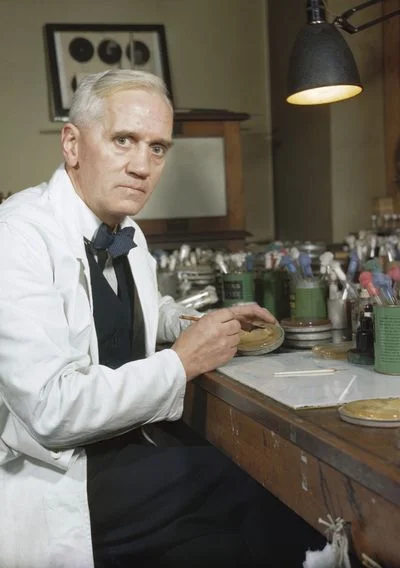
Penicillin discoverer: Fleming saved countless lives from bacterial infection.
Conversation Starters
Life Journey
Alexander Fleming was born on a remote farm in rural Scotland. He was the seventh of eight children and grew up in the Scottish countryside, developing keen observational skills that would later prove invaluable.
After his father's death, Fleming moved to London to live with his older brother Thomas, a physician. This move would ultimately lead him into the world of medicine.
Fleming worked as a clerk in a shipping office for four years. A small inheritance later allowed him to pursue medical education, changing the course of his life and medical history.
Fleming enrolled at St. Mary's Hospital Medical School in Paddington. He excelled in his studies, winning numerous prizes and scholarships throughout his medical training.
Fleming graduated with distinction from St. Mary's and joined the research team of Sir Almroth Wright, a pioneer in vaccine therapy. This marked the beginning of his career in bacteriology.
Fleming became one of the first physicians to administer Salvarsan, the new treatment for syphilis. His skilled technique made him a pioneer in applying this breakthrough therapy.
During World War I, Fleming served as a captain in the Royal Army Medical Corps. Working in field hospitals, he witnessed countless soldiers dying from infected wounds, inspiring his search for antibacterials.
Fleming published research showing that antiseptics used to treat wounds often did more harm than good, killing more white blood cells than bacteria. This controversial finding challenged conventional medical wisdom.
After the war, Fleming returned to St. Mary's Hospital to continue his research. He was appointed assistant director of the Inoculation Department, focusing on bacteriology.
Fleming discovered lysozyme, a natural antibacterial enzyme found in tears, saliva, and mucus. Though not powerful enough for clinical use, this discovery showed that the body has natural defenses against bacteria.
Fleming noticed that mold contaminating a bacterial culture had killed surrounding bacteria. This accidental observation led to the discovery of penicillin, a breakthrough that would transform medicine.
Fleming published his findings on penicillin in the British Journal of Experimental Pathology. The paper received little attention initially, and penicillin's potential remained unexplored for over a decade.
Fleming was appointed Professor of Bacteriology at St. Mary's Hospital Medical School. He continued research on penicillin but lacked resources to develop it for clinical use.
Howard Florey and Ernst Boris Chain at Oxford University developed methods to produce penicillin in quantity. Their work finally brought Fleming's discovery to practical medical application.
American pharmaceutical companies began mass-producing penicillin for the war effort. The antibiotic saved countless lives during World War II, revolutionizing the treatment of bacterial infections.
Fleming was knighted for his contributions to medicine. He was also elected Fellow of the Royal Society in recognition of his groundbreaking scientific achievements.
Fleming shared the Nobel Prize in Physiology or Medicine with Howard Florey and Ernst Chain. The prize recognized their roles in discovering and developing penicillin into a life-saving drug.
Sir Alexander Fleming died of a heart attack in London. He was buried at St. Paul's Cathedral, an honor reflecting his immense contribution to humanity through the discovery of penicillin.