Quick Facts
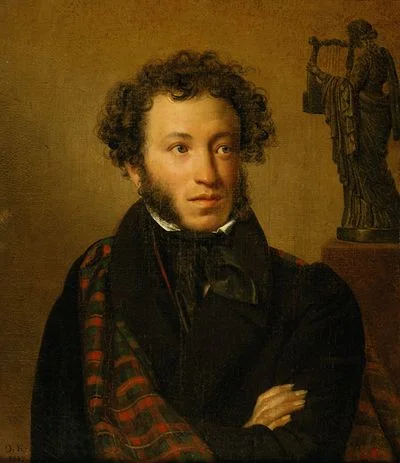
Russia's Shakespeare:" Pushkin, father of modern Russian literature.
Conversation Starters
Life Journey
Alexander Sergeyevich Pushkin was born into an aristocratic family with African ancestry through his maternal great-grandfather Abram Gannibal. He would become Russia's greatest poet and founder of modern Russian literature.
Young Pushkin had access to his father's extensive library and began reading voraciously. His grandmother and nanny Arina Rodionovna introduced him to Russian folklore and fairy tales that would later inspire his work.
Pushkin was selected to join the newly established Imperial Lyceum, an elite school for noble children. Here he developed his poetic talents and formed lifelong friendships with future Decembrist revolutionaries.
His poem 'To a Poet Friend' was published in the journal 'Vestnik Evropy', marking his literary debut. His talents were recognized by the great poet Derzhavin at a Lyceum examination.
Pushkin graduated and entered the Ministry of Foreign Affairs as a civil servant. He became part of St. Petersburg's literary circles and began writing political verses that would soon attract government attention.
His first major narrative poem 'Ruslan and Lyudmila' brought him nationwide fame. The epic fairy tale in verse established him as the leading Russian poet of his generation.
His political verses led to exile from St. Petersburg. He was transferred to the south, traveling through the Caucasus, Crimea, and Bessarabia, experiences that would inspire 'The Prisoner of the Caucasus' and other works.
Pushkin started his masterpiece 'Eugene Onegin', a novel in verse that would take eight years to complete. It became the definitive work of Russian literature, creating the 'superfluous man' archetype.
After conflicts with authorities, Pushkin was confined to his mother's estate. Despite the isolation, this became one of his most productive periods, where he wrote 'Boris Godunov' and continued 'Eugene Onegin'.
Pushkin completed his historical tragedy about the Time of Troubles. The play revolutionized Russian drama and later inspired Mussorgsky's famous opera of the same name.
Many of Pushkin's Lyceum friends participated in the failed Decembrist revolt. His exile ironically saved him from involvement, though he sympathized with the rebels and their fate haunted him.
Tsar Nicholas I personally pardoned Pushkin and offered to be his personal censor. This complex relationship gave Pushkin freedom to publish while subjecting him to constant surveillance.
Pushkin married the beautiful Natalia Goncharova after years of courtship. Their marriage was turbulent, with Natalia's beauty attracting admirers and causing jealousy that would ultimately prove fatal.
After eight years, the complete 'Eugene Onegin' was published. The work established the modern Russian literary language and became the foundational text of Russian literature.
Pushkin created one of his greatest poems about the famous equestrian statue of Peter the Great. The narrative poem explores the conflict between individual fate and state power during the 1824 flood.
The Tsar appointed Pushkin as Kammerjunker, a junior court title insulting for a man of his age and stature. The position kept him in debt-ridden St. Petersburg and fueled social tensions.
His historical novel about the Pugachev Rebellion was published in his literary journal 'The Contemporary'. It remains one of the finest examples of Russian historical fiction.
Pushkin died from wounds sustained in a duel with Georges d'Anthès, who had been pursuing his wife. His death at 37 was mourned throughout Russia, and he was buried at Svyatogorsk Monastery.