Chumi
BackChat
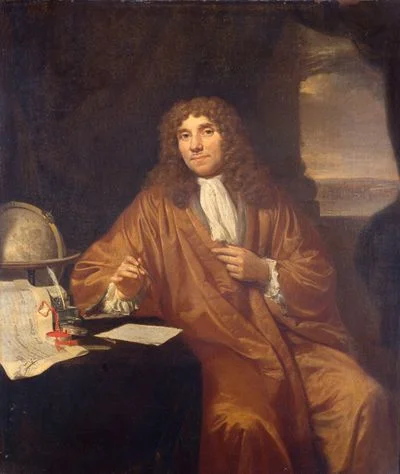
Anthony van Leeuwenhoek

Anthony van Leeuwenhoek

Scientist

Start Chat

AI Personality

Quick Facts

Father of Microbiology
Discovering bacteria
Improving microscopes

Life Journey

1632Born in Delft, Netherlands

Antoni van Leeuwenhoek was born to Margaretha Jacobsdochter van den Berch and Thonis Philipszoon, a basket maker. He was one of five surviving children from a modest Dutch family.

1638Father dies

Leeuwenhoek's father died when he was only six years old. His mother remarried Jacob Molijn, a painter, who would raise young Antoni.

1648Apprenticed to a linen draper

Van Leeuwenhoek moved to Amsterdam to apprentice with a linen draper, where he first encountered magnifying glasses used to inspect cloth quality, sparking his interest in lenses.

1654Returns to Delft and marries

Van Leeuwenhoek returned to Delft, married Barbara de Mey, and established his own drapery business. They would have five children, though only daughter Maria survived to adulthood.

1660Appointed chamberlain to Delft sheriffs

Van Leeuwenhoek secured a position as chamberlain to the Delft sheriffs, a stable municipal post that provided income while allowing time for his scientific pursuits.

1666First wife dies; remarries

Barbara de Mey died in 1666. Van Leeuwenhoek married Cornelia Swalmius in 1671, who would support him throughout his scientific career until her death in 1694.

1668Begins constructing microscopes

Van Leeuwenhoek began grinding his own lenses and constructing simple microscopes. His instruments achieved magnifications up to 270x, far superior to compound microscopes of the era.

1673First letter to the Royal Society

Van Leeuwenhoek sent his first letter to the Royal Society of London describing observations of bee stings, mold, and lice. This began a 50-year correspondence comprising over 300 letters.

1676Discovers microorganisms in water

Van Leeuwenhoek discovered 'animalcules' (microorganisms) in pond water and rainwater, becoming the first human to observe single-celled life. This discovery founded microbiology.

1677Discovers spermatozoa

Van Leeuwenhoek first observed and described spermatozoa, calling them 'animalcules' in semen. He recognized their role in reproduction, though debates continued for decades.

1680Elected Fellow of the Royal Society

Despite no formal education or knowledge of Latin, van Leeuwenhoek was elected Fellow of the Royal Society in recognition of his extraordinary microscopic discoveries.

1683Observes bacteria for the first time

Van Leeuwenhoek scraped plaque from his teeth and observed bacteria, becoming the first person to see these microorganisms. He described rod-shaped, spiral, and spherical forms.

1688Describes blood capillaries and cells

Van Leeuwenhoek provided detailed descriptions of red blood cells and observed blood flow through capillaries, confirming William Harvey's circulation theory at the microscopic level.

1702Discovers parthenogenesis in aphids

Van Leeuwenhoek observed that female aphids could reproduce without males, discovering parthenogenesis. He also studied rotifers and other microscopic creatures.

1717Visited by Tsar Peter the Great

Russian Tsar Peter the Great visited van Leeuwenhoek in Delft to see his famous microscopes and learn about his discoveries, demonstrating his international scientific reputation.

1723Dies in Delft

Antoni van Leeuwenhoek died at age 90. He had built over 500 microscopes and discovered protozoa, bacteria, spermatozoa, blood cells, and muscle fibers, earning the title 'Father of Microbiology.'

Chat