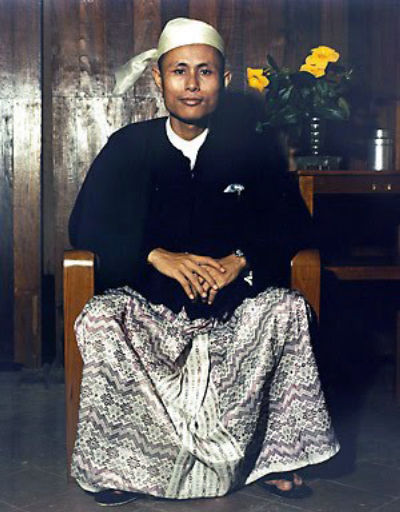
Quick Facts
Charismatic Burmese revolutionary who forged independence pathways, built a national army, and was assassinated before statehood.
Conversation Starters
Life Journey
He was born in Natmauk, a town in central Burma under British colonial rule. Growing up amid nationalist ferment, he was shaped by Buddhist schooling and the politics of imperial administration.
He enrolled at Rangoon University, where campus debate and strikes fueled anti-colonial activism. He joined student organizations that challenged British authority and promoted Burmese self-determination.
As a leading student activist, he helped organize a major strike after disciplinary actions against student leaders. The protest elevated him nationally and linked student power to broader nationalist movements.
He rose within the Dobama Asiayone (We Burmans Association), adopting the honorific "Thakin" to assert Burmese mastery of their own land. The group nurtured future leaders and sharpened mass anti-colonial messaging.
He helped establish the Communist Party of Burma alongside other radicals seeking systemic change under colonialism. The party’s networks and publications strengthened underground organizing and ideological discipline.
He joined with Ba Maw and other leaders to coordinate anti-British forces through the Freedom Bloc. The coalition aimed to merge labor, student, and nationalist energy into a single political front.
Facing colonial surveillance and arrests, he left Burma covertly to seek international backing for armed struggle. His search brought him into contact with Japanese agents as war loomed in Asia.
He and other future officers trained in Japanese-controlled programs to prepare for an invasion of Burma. The instruction emphasized guerrilla tactics and command structure, laying groundwork for a new Burmese force.
He emerged as the central organizer among the "Thirty Comrades," a handpicked cadre meant to seed a national army. Their oath-bound unity became a founding myth for modern Burmese military nationalism.
He married Khin Kyi, who later became a senior public figure in independent Burma. Their partnership anchored his personal life during wartime upheaval and constant political risk.
He helped create the Burma Independence Army (BIA) as Japanese forces advanced and British administration collapsed. The BIA recruited rapidly and sought to turn military momentum into political liberation.
Under Ba Maw’s government, he held the War Minister portfolio while Japan claimed to grant Burma nominal independence. He grew disillusioned as repression and exploitation revealed Japan’s imperial aims.
He worked with communists and socialists to form the Anti-Fascist Organization, later the Anti-Fascist People’s Freedom League (AFPFL). The alliance prepared a coordinated break with Japan and a return to mass politics.
On 27 March, he led the Burma National Army’s uprising against Japanese forces, aligning with the Allies. The shift recast him as a pragmatic nationalist willing to reverse course to secure true independence.
He rose as the foremost AFPFL leader, mobilizing public pressure while negotiating with British officials. His authority blended popular legitimacy with military influence, making him central to the transition plan.
In talks with British Prime Minister Clement Attlee’s government, he secured an agreement setting Burma on a path to independence. The deal advanced a timetable and validated the AFPFL as the main negotiating partner.
He negotiated at Panglong with Shan, Kachin, and Chin leaders to build a future Union of Burma. The agreement promised autonomy principles and cooperation, aiming to prevent fragmentation after British withdrawal.
Gunmen attacked the Secretariat while he met with colleagues, killing him and several cabinet members. The assassination, widely linked to rival politician U Saw, shocked the country just months before independence.