Quick Facts
Charlemagne: United Europe, revived learning, forged an empire.
Conversation Starters
Life Journey
Charles was born to Pepin the Short and Bertrada of Laon, members of the Carolingian dynasty. The exact location of his birth remains uncertain, with both Aachen and Liège being suggested. He grew up in a royal household that was actively reshaping the political landscape of Western Europe.
Pepin the Short deposed the last Merovingian king, Childeric III, and was crowned King of the Franks with papal approval. This momentous event established the Carolingian dynasty and set the precedent for the close relationship between the Frankish crown and the papacy that would shape Charles's reign.
Young Charles and his brother Carloman were anointed by Pope Stephen II along with their father in the abbey of Saint-Denis. This sacred ritual reinforced the divine legitimacy of Carolingian rule and forged an unbreakable bond between the Frankish monarchy and the Roman Church.
Upon Pepin's death, the kingdom was divided between Charles and his younger brother Carloman according to Frankish custom. Charles received the outer, crescent-shaped portion including Aquitaine, while Carloman got the central regions. Relations between the brothers were often tense and competitive.
Carloman's sudden death left Charles as the sole ruler of the Frankish kingdom. Rather than honor the rights of his young nephews, Charles quickly seized Carloman's territories, forcing his sister-in-law and her children to flee to the Lombard court in Italy.
Charles began a brutal thirty-year campaign to conquer and Christianize the pagan Saxons of northern Germany. He destroyed their sacred Irminsul pillar and initiated a cycle of conquest, revolt, and repression that would define much of his reign and forever alter the religious landscape of northern Europe.
Responding to Pope Hadrian I's appeal, Charles crossed the Alps and besieged the Lombard capital of Pavia for nearly a year. After King Desiderius surrendered, Charles assumed the Iron Crown of Lombardy, adding 'King of the Lombards' to his titles and establishing Frankish dominance over Italy.
During his retreat from an unsuccessful campaign in Spain, Charles's rearguard was ambushed and annihilated by Basque warriors in the Pyrenees. Among the fallen was his nephew Roland, whose death would later inspire the legendary chanson de geste, 'The Song of Roland,' one of the oldest surviving works of French literature.
Pope Hadrian I crowned Charles's young sons as sub-kings: Pepin as King of Italy and Louis as King of Aquitaine. This arrangement allowed Charles to delegate regional governance while maintaining supreme authority, and it demonstrated the intimate cooperation between Carolingian power and papal sanction.
Following a major Saxon revolt and military defeat, Charles ordered the execution of approximately 4,500 Saxon prisoners in a single day. This brutal act of repression, one of the most controversial episodes of his reign, demonstrated his determination to crush Saxon resistance and enforce Christian conversion.
The legendary Saxon leader Widukind finally surrendered and accepted baptism with Charles serving as his godfather. This marked a turning point in the Saxon Wars, though sporadic resistance would continue for nearly two more decades before Saxony was fully incorporated into the Carolingian realm.
Charles promulgated the Admonitio Generalis, a comprehensive decree reforming the Frankish Church and education system. This landmark legislation mandated the establishment of schools at every cathedral and monastery, prescribed standardized texts and liturgy, and laid the foundation for the Carolingian Renaissance.
Charles launched a massive military campaign against the Avar Khaganate, a powerful nomadic empire that had terrorized Eastern Europe for centuries. Over several campaigns, Frankish forces captured the legendary Ring, the fortified Avar treasury containing centuries of accumulated plunder from raids across the Byzantine Empire and beyond.
Charles presided over a major church council that addressed theological controversies including Adoptionism and the Byzantine iconoclast debate. The council's decisions, issued under royal authority, demonstrated Charles's growing role as the supreme arbiter of religious affairs in the West, rivaling the Byzantine emperor's authority.
Under the guidance of Alcuin of York, Charles transformed his court at Aachen into the intellectual center of Western Europe. The Palace School attracted scholars from across Christendom, produced beautiful illuminated manuscripts, and developed the Carolingian minuscule script that would become the basis for modern lowercase letters.
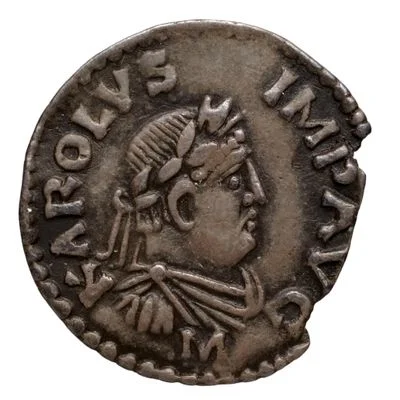
On Christmas Day, Pope Leo III crowned Charles as 'Emperor of the Romans' in St. Peter's Basilica, reviving the Western Roman Empire after more than three centuries. Though Charles reportedly claimed surprise at the coronation, the event represented the culmination of decades of Frankish expansion and the formal recognition of his supreme status in Western Christendom.
Charles issued major capitularies reforming law, administration, and social organization throughout his empire. He dispatched missi dominici (royal envoys) to ensure compliance with imperial decrees, codified tribal laws, and established a more uniform system of weights and measures that facilitated trade across his vast domains.
Charles issued the Divisio Regnorum, dividing his empire among his three legitimate sons: Charles the Younger, Pepin, and Louis. Following Frankish tradition, each son would rule an independent kingdom while maintaining family unity. However, the deaths of Charles and Pepin before their father would ultimately leave Louis as sole heir.
With his other sons deceased, the aging Charles crowned his youngest son Louis as co-emperor in a ceremony at Aachen. Significantly, Charles placed the crown on Louis's head himself without papal involvement, asserting imperial independence and establishing a precedent for Carolingian succession.
Charlemagne died after a brief illness at his beloved palace in Aachen and was buried in the Palatine Chapel. He left behind an empire stretching from the Pyrenees to the Elbe, a cultural and educational renaissance, and a legacy as the 'Father of Europe' that would inspire emperors and kings for centuries to come.