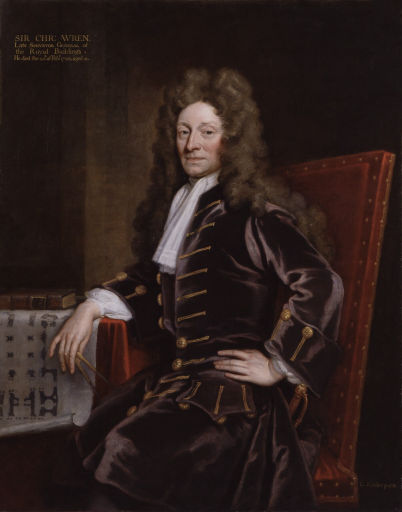
Quick Facts
A brilliant polymath who reshaped London after the Great Fire through elegant science-informed architecture and civic ambition.
Conversation Starters
Life Journey
Born on 30 October 1632 to Christopher Wren the Elder, a Church of England clergyman, and Mary Cox. Growing up amid political tension before the Civil Wars, he absorbed scholarly habits and Anglican culture early.
As a child he was taught by tutors connected to cathedral and court circles, gaining early exposure to geometry and drafting. He built small mechanical devices and learned to think in diagrams, a skill later vital for architecture.
At Westminster School he studied classical languages alongside rigorous mathematics under Richard Busby. The school’s intellectual discipline and London connections helped place him among the era’s most promising young scholars.
He entered Wadham College, Oxford, where experimental philosophy flourished despite national upheaval after Charles I’s execution. Wren joined a circle of natural philosophers exploring astronomy, optics, and measurement with practical rigor.
After completing his degree, he pursued mathematical problems and observational astronomy with increasing sophistication. His facility with instruments and diagrams made him useful to senior scholars building England’s new scientific culture.
Wren became Professor of Astronomy at Gresham College, a prominent London post emphasizing public lectures and practical science. The position brought him into close contact with Robert Hooke and other experimentalists shaping modern inquiry.
In Restoration London, he participated in regular meetings devoted to experiments, instruments, and mathematical demonstrations. These gatherings soon formed the Royal Society, where Wren’s clarity of explanation earned wide respect.
When the Royal Society received its royal charter, Wren was included among its foundational Fellows. He contributed designs, observations, and technical proposals, helping legitimize experimental science as a national institution.
Wren took the prestigious Savilian Chair at Oxford, one of England’s foremost mathematical posts. The role amplified his scientific reputation and gave him authority in geometry and measurement that later supported large building programs.
He visited Paris and met leading intellectuals, observing new classical architecture and engineering methods. French buildings and urban planning, including dome design, broadened his aesthetic vocabulary beyond English tradition.
After the Great Fire devastated the City, Wren drafted a bold reconstruction scheme with broad avenues and coordinated planning. Although property rights blocked full adoption, his proposals positioned him as a central rebuilding authority.
Appointed Surveyor of the King’s Works, he oversaw royal commissions and large-scale construction standards. Working within the Restoration state, he coordinated craftsmen, finances, and structural decisions across multiple sites.
After earlier designs were rejected or overtaken by events, construction began on a new St Paul’s to replace the medieval cathedral. Wren balanced liturgical expectations, civic symbolism, and engineering constraints for a monumental rebuild.
Work advanced under a design that evolved through approvals, models, and on-site adjustments. He managed stone supply, structural systems, and workforce coordination, turning mathematical proportion into buildable form over decades.
Wren served as President of the Royal Society, presiding over meetings that included Robert Hooke and later Isaac Newton. His leadership reinforced the Society’s reputation for disciplined experiment and careful public communication.
By the 1680s his post-Fire church program produced distinctive spires and interiors, including works such as St Stephen Walbrook. These buildings blended classical language with English urban needs, shaping London’s skyline for centuries.
He married Jane FitzWilliam, forming a later-life household after years devoted to public works and previous family ties. The marriage connected him to established social networks while he continued directing major construction.
By 1708 the cathedral’s main structure and dome were substantially finished, allowing regular worship in a transformed civic landmark. The project symbolized London’s recovery and the Restoration state’s confidence in orderly design.
Late in life he was displaced from the Surveyor role as court politics and administrative priorities shifted under the Hanoverian era. Despite controversy, his built legacy and professional methods remained deeply influential in Britain.
He died on 25 February 1723, leaving an extraordinary body of churches and public buildings across London. He was interred in St Paul’s, where the memorial message invites visitors to look around at his work.