Quick Facts
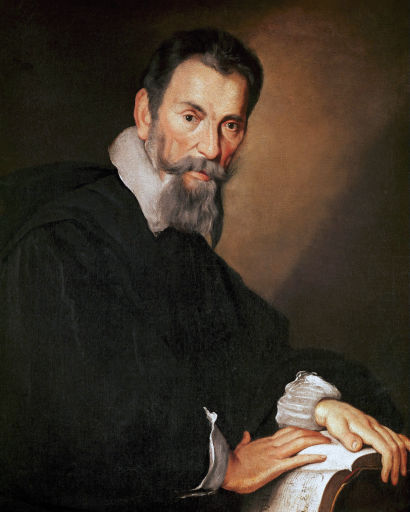
A bold Italian composer who bridged Renaissance polyphony and Baroque drama, transforming opera with vivid musical storytelling.
Conversation Starters
Life Journey
Born in Cremona in the Duchy of Milan, then under Spanish Habsburg influence. He grew up in a cathedral-centered musical world shaped by Italian humanism and church patronage.
As a boy, he studied singing, counterpoint, and composition in Cremona’s ecclesiastical milieu. Local masters and the city’s renowned instrument makers provided an unusually rich musical environment.
He issued an early sacred print in Cremona, signaling professional ambitions beyond a cathedral apprenticeship. Printing gave his music a wider reach in northern Italian courts and chapels.
His first madrigal book placed him in the competitive world of Italian secular vocal music. The publication connected him to elite patrons who prized refined poetry and expressive counterpoint.
He joined Duke Vincenzo I Gonzaga’s musical establishment, a major hub of late Renaissance culture. Court life demanded rapid composition for ceremonies, theater, and diplomatic spectacle.
As his responsibilities expanded, he wrote madrigals and occasional works for Gonzaga festivities. Mantua’s cosmopolitan circle exposed him to new theatrical styles and daring text expression.
He married Claudia de Cattaneis, a singer at the Mantuan court, intertwining family life with demanding court schedules. Their household faced frequent travel and the uncertainty of patronage politics.
Giovanni Maria Artusi attacked his bold dissonances as violations of established counterpoint rules. Monteverdi answered by framing a new expressive priority—text and affect—later called the 'seconda pratica.'
The Fifth Book showcased sharper word-painting and freer harmonic tension aligned to poetry. Its preface and musical examples strengthened his reputation as a leader of the new, emotionally direct manner.
He presented L'Orfeo for the Accademia degli Invaghiti in Mantua, combining recitative, aria, chorus, and rich instrumentation. The work set a new standard for opera as sustained musical drama.
For Gonzaga celebrations, he composed the opera Arianna; most is lost, but the surviving 'Lamento d’Arianna' became a model of staged grief. Its emotional immediacy spread widely in printed and adapted forms.
Claudia de Cattaneis died after years of strain amid Monteverdi’s heavy workload and frequent obligations. The loss deepened the elegiac tone in his music and complicated his position at court.
He issued the monumental 1610 Vespers alongside a mass, likely aiming at elite church appointments. The collection demonstrated mastery of old-style polyphony and modern concerted writing with instruments.
He won the prestigious post at Basilica di San Marco, succeeding a tradition of Venetian splendor in sacred music. He reorganized the chapel’s forces and composed for major civic-religious ceremonies.
The Seventh Book highlighted solo and ensemble pieces with continuo, reflecting new chamber aesthetics. It showed how madrigals could absorb theatrical immediacy while remaining suitable for elite salons.
During the devastating plague in Venice, he continued serving San Marco amid civic crisis and mourning. The period sharpened his sacred output and reinforced the role of music in public resilience and ritual.
Late in life he entered the priesthood, aligning personal devotion with his prominent church position. The change reflected a mature synthesis of theatrical genius and ecclesiastical responsibility.
With Venice’s first public opera houses, he reengaged the stage for paying audiences beyond court patronage. The new market rewarded dramatic clarity, compelling melodies, and flexible scene-by-scene structure.
He composed Il ritorno d’Ulisse in patria for the Venetian public stage, blending mythic narrative with human psychology. The score shows economical orchestration and powerful recitative-driven characterization.
His late masterpiece L’incoronazione di Poppea portrayed Roman power politics with unprecedented moral ambiguity and sensual lyricism. Soon after, he fell ill while traveling and died, revered across Venice’s musical world.
He died in Venice and was buried at Santa Maria Gloriosa dei Frari, an honor reflecting civic esteem. His legacy shaped Baroque opera, sacred concertato style, and the expressive aims of Western music.