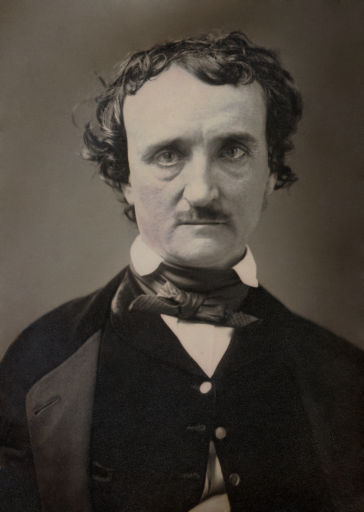
Quick Facts
A master of Gothic dread and razor-sharp criticism, he shaped modern horror, detective fiction, and poetry.
Conversation Starters
Life Journey
Born in Boston, Massachusetts, to actors David Poe Jr. and Elizabeth Arnold Hopkins Poe. His parents toured the American theater circuit, leaving the family financially unstable and socially precarious.
After his mother Elizabeth died in Richmond and his father disappeared, he was separated from his siblings. He was informally taken into the household of merchant John Allan and Frances Allan, gaining the middle name 'Allan.'
John Allan moved the family to Britain, where Poe attended schools in Scotland and England. Exposure to older European architecture and literature later fed his taste for Gothic settings and atmosphere.
Back in Richmond, he became known for strong reading skills, poetry, and sharp wit among classmates. Tensions grew with John Allan over money and expectations, setting a pattern of conflict and independence.
He entered the University of Virginia under Thomas Jefferson's new academic model and studied languages. Gambling debts and insufficient funds from John Allan forced him to withdraw after a year amid deep resentment.
After a break with John Allan, he enlisted as 'Edgar A. Perry' and served as an artilleryman. Military discipline and clerical work sharpened habits of precision that later supported his editorial career.
His debut book appeared in a small printing, credited only to 'a Bostonian.' Though it attracted little notice, it announced his ambition to build a literary identity beyond the Allan household.
He was honorably discharged after seeking advancement and support from John Allan. That year he issued 'Al Aaraaf, Tamerlane, and Minor Poems,' pushing a more ambitious, lyrical style despite limited sales.
With John Allan's backing, he entered the United States Military Academy at West Point. He soon engineered dismissal by refusing duties, preferring literature to a military career and widening the family rupture.
He released 'Poems' with help from West Point cadets who subscribed to fund it. The volume signaled a pivot from soldiering to authorship, as he sought magazine work to survive.
His tale won a prize from the Baltimore Saturday Visiter, bringing important visibility. The win helped him meet editors and patrons, proving he could compete in the booming American magazine market.
He joined the Southern Literary Messenger and quickly boosted its reputation with fierce reviews and vivid fiction. His exacting criticism made him famous and feared, while recurring financial and drinking troubles followed.
He married Virginia Clemm, the young daughter of his aunt Maria Clemm, in a union that mixed affection with precarious economics. The household depended on uncertain editorial wages and constant moves between cities.
His only completed novel blended sea adventure with surreal terror and ambiguous racial politics. Published in book form, it showed his willingness to test popular genres while maintaining a dark, psychological edge.
He published 'The Murders in the Rue Morgue,' introducing C. Auguste Dupin and the method of ratiocination. The story pioneered clues, analysis, and revelation in a form later echoed by Conan Doyle and others.
His tale of a guilty narrator and relentless heartbeat pushed horror inward, emphasizing obsession and unreliable perception. It fit magazine demands for intensity while demonstrating his theory of concentrated emotional effect.
'The Raven' became a sensation after publication, bringing national recognition but little financial security. Public readings and reprints made him a celebrity, while he continued grinding editorial work to pay bills.
Virginia died after years of tuberculosis, devastating Poe and deepening themes of mourning and idealized beauty in his work. Friends in New York observed his erratic grief as he struggled to stabilize his health and income.
He issued 'Eureka: A Prose Poem,' proposing a speculative universe shaped by attraction and repulsion. Though not scientific in method, it revealed his appetite for systems, unity, and intellectual audacity beyond fiction.
He was discovered delirious near a polling place and taken to Washington College Hospital, where he died days later. The cause remains disputed—illness, alcohol, or violence—fueling legends around his final hours.