Quick Facts
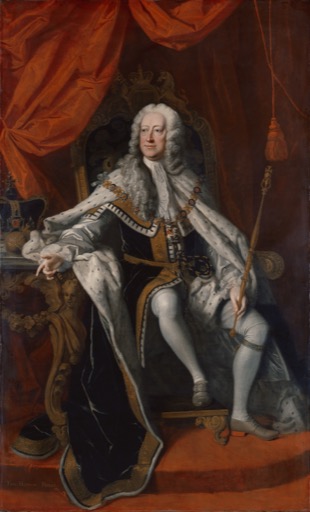
Last British monarch to personally lead troops in battle, ruling during a transformative era of colonial expansion and European warfare.
Conversation Starters
Life Journey
George Augustus was born at Herrenhausen Palace to George Louis, Electoral Prince of Hanover, and Sophia Dorothea of Celle. He was destined to become the second Hanoverian monarch of Great Britain.
His parents' marriage was dissolved due to his mother's affair with Count Königsmarck. Sophia Dorothea was imprisoned in Ahlden Castle, and George never saw his mother again, shaping his complex emotional character.
The English Parliament passed the Act of Settlement, establishing the Hanoverian succession to the British throne. This legislation would eventually make George second in line to become King of Great Britain.
George married Princess Caroline of Ansbach, a highly intelligent woman who would become his trusted advisor. Their marriage, though sometimes turbulent, produced eight children and a lasting political partnership.
George distinguished himself in the War of the Spanish Succession, fighting bravely at the Battle of Oudenarde under the Duke of Marlborough. His horse was shot from under him, but he continued fighting on foot.
Upon Queen Anne's death, George's father ascended to the British throne as George I. George became Prince of Wales and heir apparent, though his relationship with his father remained deeply strained.
After a violent quarrel with his father over the christening of his son, George and Caroline were expelled from St. James's Palace. They established a rival court at Leicester House that became a center for opposition politics.
Upon his father's death, George was crowned King George II of Great Britain and Ireland, and Elector of Hanover. He initially attempted to dismiss Robert Walpole but was persuaded by Queen Caroline to retain him.
Despite personal animosity, George retained Sir Robert Walpole as Prime Minister on Caroline's advice. This pragmatic decision maintained political stability during the early years of his reign.
Queen Caroline died after a painful illness. George was devastated, reportedly telling her on her deathbed that he would never remarry. He kept his promise and mourned her deeply for the rest of his life.
Britain declared war on Spain, beginning the War of Jenkins' Ear. This conflict would merge into the larger War of Austrian Succession, testing George's military leadership and diplomatic skills.
George personally led his troops to victory at the Battle of Dettingen against the French, becoming the last British monarch to command an army in battle. His courage under fire earned him widespread admiration.
Bonnie Prince Charlie landed in Scotland and raised a Jacobite army that invaded England. The rebellion threatened George's throne but was ultimately crushed at the Battle of Culloden in 1746.
The Duke of Cumberland, George's son, decisively defeated the Jacobite forces at Culloden. This victory ended the Stuart claim to the throne forever and secured the Hanoverian succession permanently.
The War of Austrian Succession ended with the Treaty of Aix-la-Chapelle. Though the peace was largely inconclusive, Britain's colonial and maritime power had grown significantly during the conflict.
The Seven Years' War erupted, becoming a truly global conflict. George navigated complex alliances with Prussia while Britain fought France across Europe, India, North America, and the seas.
William Pitt the Elder took control of the war effort, transforming British fortunes. Under his leadership and George's support, Britain would achieve unprecedented military successes across the globe.
George II died suddenly at Kensington Palace from an aortic aneurysm while sitting on the toilet. He was succeeded by his grandson George III, as his eldest son Frederick had predeceased him.