Quick Facts
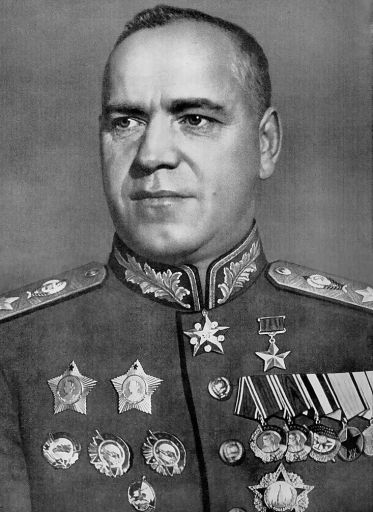
A hard-driving Soviet marshal who shaped World War II victories, balancing ruthless discipline with strategic brilliance under Stalin.
Conversation Starters
Life Journey
Born into a poor peasant household in Strelkovka, Kaluga Governorate, in the Russian Empire. Early hardship and rural life shaped his toughness and ambition long before he entered the army.
Drafted into the Imperial Russian Army during World War I and assigned to cavalry service. He learned frontline discipline and small-unit leadership in brutal conditions as the empire began to fracture.
Recognized for courage in combat and received the Cross of St. George, one of imperial Russia’s highest honors for enlisted valor. The decoration marked him as an exceptionally fearless junior cavalryman.
After the revolutions and imperial collapse, he enlisted in the Red Army and fought in the civil war. The conflict hardened his outlook and tied his future to the Bolshevik state and its military institutions.
Rose steadily through the cavalry ranks and took command responsibilities in the early Soviet armed forces. He focused on rigorous training, discipline, and practical field readiness amid rapid army reforms.
Commanded Soviet and Mongolian forces against Japan near the Khalkhin Gol river and executed a decisive double envelopment. The victory impressed Moscow and influenced later Soviet thinking on armored warfare and air-ground coordination.
Following success against Japan, he gained rapid promotion and greater authority within the Red Army. The elevation placed him among the top commanders as Europe moved toward total war and Soviet defenses lagged.
With Operation Barbarossa underway, he served as Chief of the General Staff and confronted catastrophic Soviet losses. He argued forcefully with Joseph Stalin over retreats and reserves while trying to stabilize collapsing fronts.
Sent to coordinate emergency defenses around besieged Leningrad and to impose order on exhausted units. His measures helped hold key approaches while civilians endured starvation and bombardment in one of history’s worst sieges.
As German forces neared the capital, he coordinated defensive lines and marshaled Siberian reserves for a winter counterattack. The December offensive pushed Wehrmacht units back, proving the USSR could survive and recover strategically.
As a senior Stavka representative, he helped coordinate operations that culminated in the encirclement of Germany’s 6th Army at Stalingrad. The victory changed the war’s momentum and showcased Soviet capacity for large-scale operational art.
Supported preparations for Kursk by emphasizing layered defenses, minefields, and deep reserves against German armored thrusts. After the offensive stalled, Soviet counterblows opened the road west and eroded German strategic initiative.
As one of the principal Soviet commanders, he helped orchestrate Operation Bagration, which shattered Germany’s Army Group Centre. The campaign liberated large parts of Belarus and demonstrated overwhelming Soviet superiority in planning and logistics.
Commanded the 1st Belorussian Front in the final drive to Berlin, coordinating massive artillery, armor, and infantry assaults. The brutal street fighting ended Nazi rule in the capital and sealed the European war’s outcome.
Represented the Soviet Union at the formal German surrender ceremony alongside Allied leaders and military representatives. The moment publicly associated him with victory, but it also intensified Stalin’s suspicion of his popularity.
After the war, Stalin curtailed his influence and shifted him from central power to regional commands. The move reflected Kremlin politics as much as military performance, limiting his public role despite his wartime stature.
Rehabilitated after Stalin’s death, he returned to the top leadership as Minister of Defense during Nikita Khrushchev’s consolidation. He pushed modernization while navigating Party oversight and fierce rivalries in the postwar military establishment.
Political tensions and fears of an independent military figure led Khrushchev’s leadership to dismiss him from the Defense Ministry. He was sidelined from public life, remaining a revered yet controlled symbol of wartime triumph.
Died in Moscow after years in semi-official retirement, with his legacy anchored in the USSR’s Great Patriotic War narrative. State commemoration and public memory emphasized his command role in decisive victories over Nazi Germany.