Quick Facts
A pious, battle-hardened crusader noble who captured Jerusalem and shaped the first fragile Latin rule in the Levant.
Conversation Starters
Life Journey
Born to Eustace II of Boulogne and Ida of Lorraine, he grew up among the frontier lordships of Lotharingia. His upbringing linked French-speaking nobles to the Empire’s border politics and church patronage networks.
Through family claims and imperial favor, he was positioned to inherit authority in the duchy of Lower Lorraine. The title drew him into the Holy Roman Empire’s power struggles and required loyalty to the Salian court.
Emperor Henry IV granted him the ducal dignity, expecting military service during the Investiture Controversy. Godfrey’s standing rose as he secured castles and vassals along the Meuse, a key imperial corridor.
He accompanied Henry IV into Italy, where imperial forces confronted Pope Gregory VII’s supporters. Fighting around Rome underscored how closely his early career was tied to imperial warfare and contested church authority.
He consolidated influence around Bouillon Castle while navigating monastic interests and local rivalries. Patronage and disputes with ecclesiastical landlords sharpened his reputation as a tough but conventionally devout lord.
After Urban II preached crusade at Clermont, he joined the armed pilgrimage alongside his brothers Eustace III and Baldwin. Financing the expedition pushed him to leverage lands and revenues to outfit knights and supplies.
He marched with a disciplined host through the Rhineland and across Hungary, negotiating passage to avoid conflict. The journey tested logistics and leadership as thousands crossed into Byzantine territory toward Constantinople.
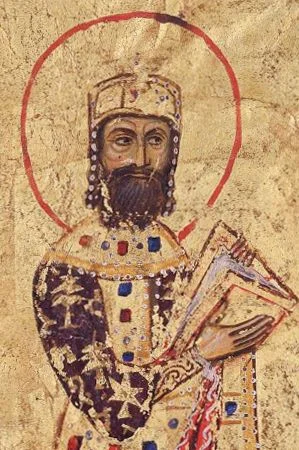
In Constantinople, he met Alexios I Komnenos and pledged to restore former Byzantine lands in exchange for support. The oath shaped uneasy crusader-Byzantine cooperation, balancing mistrust with essential provisioning and transport.
At Nicaea, crusader forces pressured the Seljuk-held city while Byzantine fleets closed the lake approach. The negotiated surrender to Alexios’ commanders frustrated many crusaders, but preserved momentum for the campaign inland.
Near Dorylaeum, crusaders repelled a fierce Seljuk assault, stabilizing the expedition after a dangerous surprise attack. Godfrey’s contingent helped hold the line as Bohemond and Raymond coordinated a hard-won victory.
At Antioch, famine and disease ravaged the crusader camp as winter tightened its grip. Godfrey remained a senior commander while negotiations, defections, and desperate sorties culminated in the city’s capture in 1098.
After Antioch fell, rival leaders argued over whether to stay, rule, or march to Jerusalem. Godfrey navigated tensions with Bohemond of Taranto and Raymond of Toulouse while trying to keep the pilgrimage’s aim intact.
He joined the final push through coastal cities, bargaining for supplies and avoiding unnecessary sieges. Cooperation with local rulers and Italian maritime interests helped sustain the army as it approached its sacred objective.
During the July assault, siege towers and coordinated attacks breached Jerusalem’s defenses held by Fatimid forces. The victory transformed the crusade into governance, forcing leaders to create institutions amid violence and scarcity.
Chosen to lead the new regime, he declined the title of king, reportedly unwilling to wear a crown where Christ wore thorns. He adopted the role of Advocate of the Holy Sepulchre, tying authority to religious guardianship.
He helped command crusader forces against a major Fatimid army sent from Egypt, winning a crucial battle that secured Jerusalem’s immediate survival. Control of nearby fortresses remained contested, but the victory boosted legitimacy.
With few knights and uncertain revenues, he relied on fortified points, negotiated truces, and support from pilgrims and Italian fleets. Relations with Patriarch Daimbert of Pisa highlighted constant friction between secular rule and church ambition.
He died after a short reign, with chroniclers citing illness amid harsh campaigning conditions and limited medical care. Buried in the Holy Sepulchre, his passing opened the way for his brother Baldwin to claim the kingship.