Quick Facts
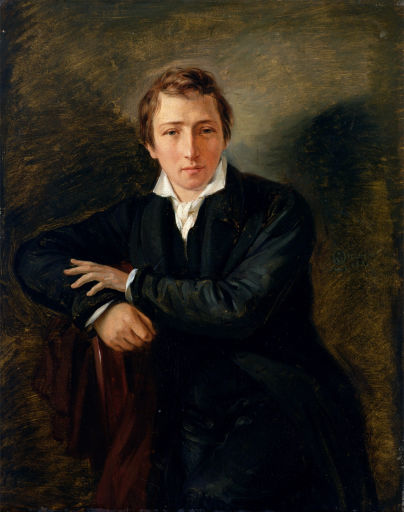
Witty German-Jewish poet and journalist whose romantic lyricism and sharp political satire shaped modern European literature.
Conversation Starters
Life Journey
He was born Harry Heine in Düsseldorf during the era of revolutionary upheaval and Napoleonic influence on the Rhineland. Raised in a Jewish household connected to trade, he absorbed French cultural currents and local German traditions early.
As Düsseldorf experienced French administrative reforms, he encountered new legal and civic ideas alongside traditional schooling. The contrast between enlightened rhetoric and social prejudice later fed his lifelong skepticism and irony.
After the Congress of Vienna reshaped German politics, his family urged practical training in business. The stifling restoration climate and narrow career expectations pushed him toward literature as an outlet for ambition and critique.
He lived with and worked for his wealthy uncle Salomon Heine, a prominent banker who became his crucial patron. The experience sharpened his sense of class difference and fueled poems that mix longing, irony, and social observation.
He entered the University of Bonn to study law, but gravitated toward literature and lectures that fed his intellectual restlessness. The post-1819 crackdown after the Carlsbad Decrees formed the repressive backdrop to his early writing.
At the University of Göttingen, he encountered a charged student culture and the pressures of antisemitic exclusion. Conflicts with academic authorities and dueling-era norms reinforced his outsider stance in German public life.
He began issuing poems that fused Romantic melody with a new, self-aware irony that unsettled traditional taste. These early publications announced a distinct lyrical voice attuned to modern disillusionment and political constraint.
He was baptized into Lutheranism, calling it his 'entry ticket' to European society in a climate of legal barriers for Jews. The conversion was pragmatic rather than devotional, and it deepened his critique of hypocrisy and assimilation pressures.
He finished his legal education at Göttingen, earning a doctorate while remaining skeptical about a conventional legal career. Literary ambition and the desire to influence public debate increasingly guided his choices over professional security.
Buch der Lieder gathered his finest early lyrics and quickly made him a central figure of German Romanticism. Many poems were later set to music by composers such as Franz Schubert and Robert Schumann, amplifying his reach.
He moved to Paris after the July Revolution, drawn by its political energy and intellectual networks. German censorship and surveillance made sustained work at home difficult, so Paris became his base for journalism and cultural critique.
From Paris he wrote sharply observed reports on French society, politics, and literature for German audiences. His accessible style and polemical edge made him influential, while also provoking authorities and conservative critics in the German states.
The German Confederation banned works associated with the Young Germany movement, and his writings were swept into the censorship net. The prohibition heightened his profile and hardened his stance that literature must confront power and hypocrisy.
He married Mathilde Mirat, a Frenchwoman with whom he maintained a complex, enduring partnership. Their household in Paris balanced bohemian instability with the practical realities of illness, money worries, and expatriate life.
He returned to German lands and witnessed the tensions between economic change and authoritarian surveillance. The journey supplied vivid scenes and targets for satire, sharpening his opposition to censorship and reactionary nationalism.
Deutschland. Ein Wintermärchen mocked the politics and pieties of the German states with biting humor and lyrical agility. The poem intensified official hostility and helped define a modern model of politically engaged European verse.
Around the revolutionary year 1848, worsening illness left him bedridden for long periods in Paris, a condition he famously called his 'mattress grave.' Despite pain and weakness, he continued writing with fierce clarity about faith, love, and history.
Romanzero showcased a darker, more compressed style, blending historical subjects, Jewish themes, and philosophical doubt. The collection demonstrated how he transformed suffering into artistic control while still challenging moral complacency.
He died after years of debilitating illness, leaving behind a body of poetry and prose that bridged Romanticism and modern political writing. He was buried in Cimetière de Montmartre, honored by admirers even as censors lingered.