Quick Facts
Visionary abbess. Composed music, wrote medicine, and saw visions that shook the medieval world.
Conversation Starters
Life Journey
Hildegard was born as the tenth child of a noble family in Bermersheim. From infancy, she experienced mystical visions, which her parents recognized as signs of divine favor.
At age eight, Hildegard was given as an oblate to the Benedictine monastery at Disibodenberg, placed under the care of the anchoress Jutta von Sponheim, who became her teacher and mentor.
Hildegard formally took her monastic vows, committing to a life of prayer, study, and contemplation. She continued to experience visions but kept them private, confiding only in Jutta.
Under Jutta's guidance, Hildegard studied Latin, the Psalter, and theological texts. Despite limited formal education, she developed profound theological insights through her visionary experiences.
Following Jutta's death, Hildegard was unanimously elected magistra of the growing community of nuns at Disibodenberg, beginning her leadership role in the monastic community.
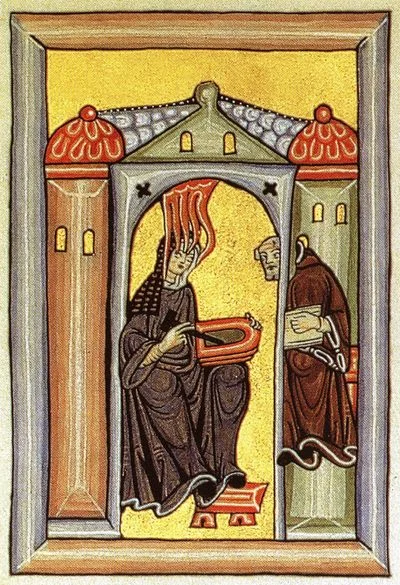
Hildegard received a divine command to write and speak publicly about her visions. With the help of her secretary Volmar, she began recording her mystical experiences in Latin.
Pope Eugenius III, at the Synod of Trier, examined and approved Hildegard's writings. He read portions of Scivias aloud and granted her official permission to continue writing her visions.
Despite opposition from the monks of Disibodenberg, Hildegard established an independent convent at Rupertsberg. This move gave her community autonomy and room to grow.
After ten years of work, Hildegard completed Scivias (Know the Ways of the Lord), her first major visionary theological work containing 26 visions explaining the history of salvation.
Hildegard composed her collection of liturgical songs, Symphonia, containing over 70 compositions. Her music was innovative, with wide-ranging melodies that expanded the boundaries of plainchant.
Hildegard completed her natural science works documenting medicinal properties of plants, animals, and stones. These works combined empirical observation with spiritual insight about creation.
Hildegard embarked on the first of four preaching tours, traveling to monasteries and public gatherings. As a woman preaching publicly, she was a remarkable exception in medieval society.
Hildegard finished her second major visionary work exploring virtues and vices through dramatic dialogues. The text presents a moral cosmology connecting human choices to cosmic order.
Hildegard established a second monastery across the Rhine at Eibingen to accommodate the growing number of women seeking to join her community, demonstrating her organizational abilities.
Hildegard completed her third and final visionary work, presenting an integrated vision of God, cosmos, and humanity. It represents her most sophisticated theological and cosmological synthesis.
Hildegard died peacefully at her monastery. Legend says that at her death, two streams of light appeared in the sky. In 2012, Pope Benedict XVI declared her a Doctor of the Church.