Quick Facts
Pioneered early ukiyo-e by transforming popular Edo culture into influential woodblock prints and illustrated books.
Conversation Starters
Life Journey
Born in Awa Province on the Boso Peninsula during the early Tokugawa peace. Growing up near textile and artisan workshops, he likely absorbed design skills that later suited book illustration and print production.
As a teenager he trained in practical arts linked to kimono patterns and decorative painting common in rural workshops. These habits emphasized clean outlines and repeatable motifs, foundations that translated well into woodblock design.
He relocated to Edo as the shogunal capital expanded into a major consumer city. There he connected with commercial publishers serving townspeople eager for illustrated fiction, fashion, and depictions of theater life.
The Great Fire of Meireki devastated Edo, forcing massive rebuilding and stimulating demand for images and printed materials. The city’s reconstruction fostered new neighborhoods and entertainment quarters that became key ukiyo-e subjects.
He began designing illustrations for woodblock-printed books sold through Edo’s bookshops. Working with publishers and block carvers, he learned how to make bold lines reproduce clearly across large print runs.
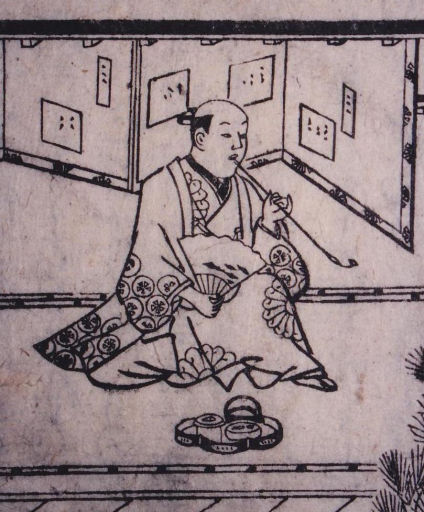
His images increasingly relied on strong black-ink outlines that defined faces, hands, and garments with speed and precision. This graphic clarity made scenes of streets and pleasure quarters immediately legible to urban buyers.
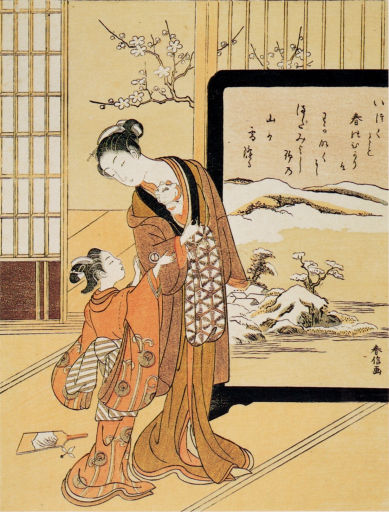
He developed figure-focused compositions showing stylish women, courtesans, and ordinary townspeople. These depictions reflected Edo’s rising merchant culture, where fashion, hair styles, and gestures signaled identity and status.
Moronobu’s career grew through collaborations with publishers who financed paper, blocks, and distribution. The teamwork of designer, carver, and printer shaped his compositions, encouraging clear contours and balanced negative space.
He produced sequences that paired images with text, supporting romances, travel writing, and urban guides. By staging characters in readable interiors and streets, he helped standardize visual storytelling in early ukiyo-e books.
He turned to the theater world and pleasure quarters that defined the “floating world” of Edo. His prints captured costumes, poses, and crowd energy, reflecting how kabuki and licensed districts shaped popular taste.
His designs began packing scenes with overlapping bodies, patterned textiles, and architectural framing. This approach created a sense of bustling space, giving viewers a panoramic feel of Edo’s streets and social gatherings.
By the late 1670s his name was strongly associated with high-demand illustration and prints for townspeople. His consistent linework and attractive figures influenced younger artists and set commercial expectations for ukiyo-e imagery.
Around this period he produced iconic bijin imagery later linked to the famous “Beauty Looking Back” motif. The poised turn of the figure and flowing garments embodied Edo ideals of elegance and became widely referenced in later eras.
He continued balancing illustrated books with stand-alone prints as markets diversified. This flexibility kept him relevant to publishers while allowing experiments in figure scale, cropping, and more immediate street-level scenes.
Although documentation is uneven, his methods circulated through assistants, copyists, and publisher networks. The repetition of his figure types and line rhythms suggests a workshop-like transmission that helped spread his style across Edo.
He died after decades serving Edo’s commercial print culture during the Tokugawa period. His synthesis of elegant figure design and reproducible linework helped establish ukiyo-e as a durable mass-medium for urban Japan.