Quick Facts
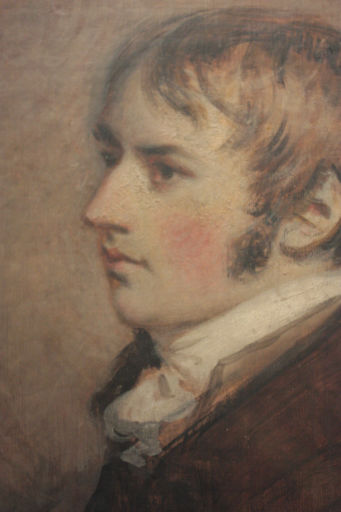
A pioneering English landscape painter who transformed ordinary countryside scenes into luminous, emotionally resonant modern art.
Conversation Starters
Life Journey
Born to Golding Constable, a prosperous corn merchant and mill owner, and Ann Watts Constable. The River Stour, Flatford Mill, and Dedham Vale scenery around East Bergholt became lifelong motifs in his art.
As a teenager he made outdoor drawings of barges, mills, and hedgerows near Flatford and Dedham. These close observations of weather and rural labor laid the groundwork for his later naturalistic landscapes.
He saw Sir George Beaumont’s collection and encountered Claude Lorrain’s landscapes, discovering how poetic light could elevate everyday scenery. The experience strengthened his resolve to pursue painting despite family expectations of business.
Constable moved to London and studied at the Royal Academy Schools, drawing from the antique and life model. He also copied Old Masters in collections and developed ambitions to make landscape painting a serious, modern art form.
He first showed work at the Royal Academy, seeking recognition in a system that favored history painting. Determined to paint “from nature,” he returned repeatedly to Suffolk to gather truthful studies of light, foliage, and air.
He refused an offer connected to service in India, judging that distance would sever him from the English landscapes he loved. The decision reinforced his commitment to a career built on direct observation of local places and weather.
He pursued a long courtship with Maria Bicknell, granddaughter of Dr. Durand Rhudde, while her family worried about his finances and prospects. Their relationship became a central emotional anchor, shaping both his ambitions and anxieties.
After years of opposition, Constable married Maria Bicknell at St Martin-in-the-Fields. The couple soon built a growing household, and he felt pressure to secure steady income through exhibitions and sales.
He exhibited 'The White Horse' at the Royal Academy, a major Stour River canvas that demonstrated his mature scale and freshness. The success helped him become an Associate of the Royal Academy, improving his standing among patrons.
Constable painted 'The Hay Wain,' presenting rural life near Flatford with sparkling light and atmospheric depth. Though initially modestly received in Britain, the painting later became an icon of English landscape and modern naturalism.
At the Paris Salon, 'The Hay Wain' impressed French artists and critics, and King Charles X awarded him a gold medal. His handling of broken color and weather influenced painters linked to Romanticism and, later, the Barbizon school.
He created oil sketches of skies on Hampstead Heath, noting time, wind, and cloud formations with near-scientific care. These studies helped him paint shifting light as a structural element rather than mere background decoration.
Maria died of illness after years of fragile health, leaving Constable a widower with seven children. Grief darkened his palette and intensified the emotional charge of later works, even as he continued to pursue recognition and stability.
He was elected a full member of the Royal Academy after a long, frustrating wait within the institution. The honor validated his insistence that landscape could rival history painting in seriousness, technique, and moral weight.
Constable collaborated with engraver David Lucas on mezzotints intended to spread his landscapes to a wider public. The venture showcased his desire to control reproduction quality, though it strained finances and demanded relentless oversight.
He gave Royal Institution-style lectures discussing composition, chiaroscuro, and the ethics of painting from nature, arguing against formulaic conventions. His remarks revealed a practical philosophy of art rooted in observation and lived experience.
Constable died after a period of declining health, having secured institutional respect but still feeling underappreciated at home compared with France. He was buried beside Maria, closing a career that permanently reshaped modern landscape painting.