Quick Facts
A disillusioned court poet turned hermit whose reflective prose captured impermanence amid Japan’s turbulent late Heian era.
Conversation Starters
Life Journey
Born in Kyoto into a family connected to the Kamo shrine complex, a key Shinto institution of the capital. His early environment mixed ritual tradition, court culture, and the refined arts of late Heian Japan.
As a boy he learned courtly music and poetic diction, skills prized among aristocrats and shrine families in Kyoto. These disciplines formed the technical base for his later waka poems and his precise prose style.
The major fire that swept Kyoto left neighborhoods in ruins and demonstrated how fragile the court city could be. The shock of seeing homes and temples vanish informed his later emphasis on mujō, the Buddhist truth of change.
When the court’s power fractured during the Genpei conflict, Kyoto’s political center shook and people faced uncertainty. He later recalled the sense of dislocation around Emperor Antoku’s era as a sign of a world losing stability.
A severe famine brought hunger, migration, and public disorder, turning the capital’s streets into scenes of desperation. His later writing describes bodies, abandoned houses, and the collapse of everyday trust during the crisis.
With Minamoto authority consolidating far from Kyoto, aristocratic life lost its old certainty and patronage patterns changed. The shift toward warrior government deepened his sense that worldly rank and office were unreliable shelters.
By his thirties he was active in Kyoto’s poetic circles and known for carefully crafted waka in an era that prized elegant allusion. His reputation connected him to compilers and patrons who shaped the canon of court poetry.
A violent windstorm tore through the capital, damaging buildings and reminding residents how quickly order could be undone. He later used the event as another concrete example of nature humiliating human pride and planning.
Family expectations and institutional politics around Kyoto’s shrine world left him dissatisfied with prospects for stable office. The setback intensified his doubts about court ambition and pushed him toward religious withdrawal.
He adopted the life of a Buddhist recluse, cutting ties with much of the competition and ceremony of the capital. The decision reflected a personal response to upheaval and to Buddhist teachings spreading in late Heian society.
His waka were selected for the imperial anthology Shin Kokin Wakashu, overseen by retired Emperor Go-Toba and leading poets. Inclusion confirmed his standing even as he moved toward seclusion, bridging court art and hermit life.
He increasingly sought quiet outside the capital, living nearer wooded hills where Buddhist practice and reading were easier. Distance from Kyoto allowed him to observe society without being trapped by its expectations and rituals.
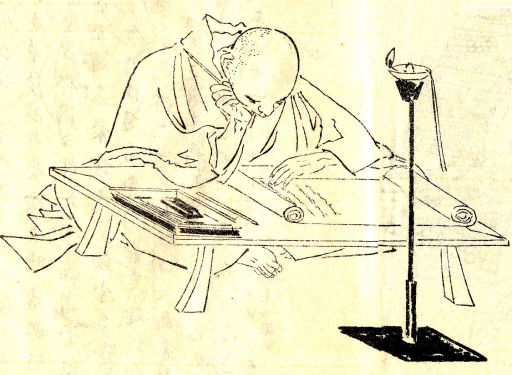
He constructed a famously small dwelling designed for simplicity, portability, and mindful detachment from possessions. The hut became a physical argument that comfort and status shrink when one commits to contemplative life.
He wrote Hojoki as a tightly observed account of fires, famine, and earthquakes alongside his own retreat from the world. The essay blends autobiographical detail with Buddhist reflection, turning Kyoto’s disasters into moral insight.
In his later years he kept writing poetry and thinking critically about the pleasures of art, music, and companionship. His self-scrutiny highlights the tension between refined taste and the Buddhist demand to loosen desire.
He died remembered as both a skilled waka poet and the author of a defining prose work on impermanence. His life story became a model for later writers who sought clarity by stepping away from political and social noise.