Quick Facts
Blacksmith's son who discovered electromagnetism. No math, pure genius, built the electric age.
Conversation Starters
Life Journey
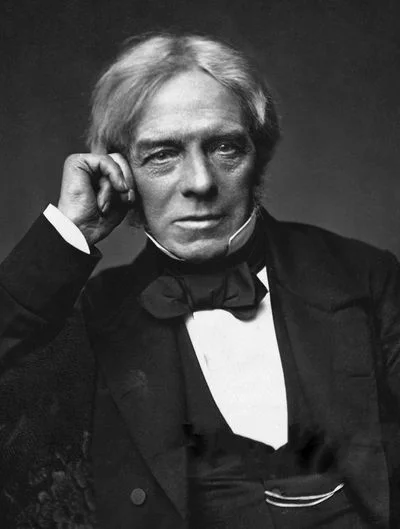
Michael Faraday was born into a poor blacksmith's family. With almost no formal education, he would become one of the greatest experimental scientists in history.
Began a seven-year apprenticeship to bookbinder George Riebau. He read many of the books he bound, developing particular interest in electricity and chemistry.
Attended four lectures by the famous chemist Humphry Davy at the Royal Institution. He took detailed notes and bound them into a book.
After sending his bound lecture notes to Davy, was hired as his laboratory assistant at the Royal Institution. This began his scientific career.
Returned from an eighteen-month tour of Europe with Davy, during which he met many leading scientists and gained invaluable experience.
Made his first significant discoveries in chemistry, including producing the first known compounds of carbon and chlorine.
Demonstrated that a magnetic field could produce continuous circular motion, building the first electric motor. This discovery founded the field of electromagnetic technology.
Discovered benzene, one of the most important substances in chemistry, while investigating oil gases. He also liquefied chlorine.
Discovered electromagnetic induction, the principle behind electric generators and transformers. This discovery made possible the electrical age.
Formulated the two laws of electrolysis, establishing quantitative relationships in electrochemistry. He also introduced terms like electrode, anode, and cathode.
Suffered a mental breakdown from overwork, forcing him to reduce his research. He would experience memory problems for the rest of his life.
Discovered the relationship between light and magnetism (Faraday effect), showing that light could be affected by magnetic fields.
Proposed that light might be electromagnetic vibrations in field lines. Though ridiculed initially, Maxwell later proved this correct.
Retired from the Royal Institution after 54 years. Queen Victoria provided him with a house at Hampton Court in recognition of his contributions.
Died peacefully at his home. Despite having no formal education, his discoveries of electromagnetic induction and field theory form the foundation of modern electrical technology.