Quick Facts
Centuries of cryptic prophecies. Plague doctor turned prophet whose verses still mystify.
Conversation Starters
Life Journey
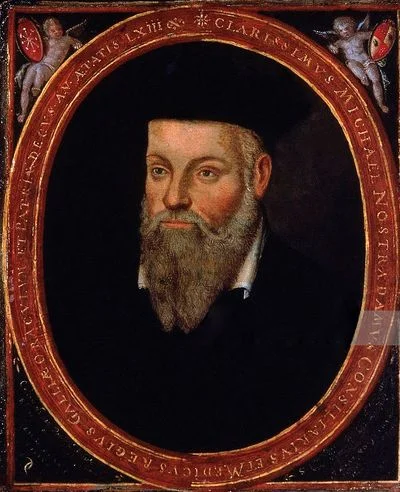
Michel de Nostredame was born to Reynière de Saint-Rémy and grain dealer Jaume de Nostredame in Provence. His family had converted from Judaism to Catholicism, and his grandfathers were learned men who introduced him to classical languages, Hebrew, and astrology.
Enrolled at the University of Avignon to study the trivium (grammar, rhetoric, and logic). However, the university was forced to close after just one year due to an outbreak of the plague, an ironic foreshadowing of his later medical career.
Spent eight years traveling through the countryside as an apothecary, learning about herbal remedies and folk medicine. This period exposed him to the practical realities of healing and the suffering caused by recurring plague epidemics.
Entered the University of Montpellier to study medicine, one of Europe's most prestigious medical schools. He was initially expelled when his past work as an apothecary was discovered, as it was considered a lowly manual trade.
Married a woman of high standing (possibly Henriette d'Encausse) and settled in Agen. They had two children together, and Nostradamus established himself as a successful physician in the community.
Tragedy struck when the plague killed his wife and both children. This devastating loss, combined with a lawsuit from his wife's family over the return of her dowry and an accusation of heresy, led to his departure from Agen.
Spent the next eight years traveling through France and Italy, working as an itinerant physician and astrologer. He developed innovative treatments for the plague, including improved sanitation and refusing to bleed patients.
Worked alongside physician Louis Serre to combat a severe plague outbreak in Marseille. His unconventional methods, including the use of rose pills and fresh air rather than bloodletting, reportedly achieved remarkable success.
The Parliament of Provence summoned him to fight the plague in Aix-en-Provence. His efforts were so valued that the city awarded him a pension for several years afterward, establishing his reputation as a plague doctor.
Married wealthy widow Anne Ponsarde and settled permanently in Salon-de-Provence. They would have six children together (three sons and three daughters), and this stable domestic life allowed him to pursue his prophetic writings.
Began publishing annual almanacs containing astrological predictions and weather forecasts. These popular publications brought him widespread fame and a steady income, as well as invitations from nobility seeking personal readings.
Published the first installment of 'Les Prophéties,' containing 353 quatrains organized into centuries. Written in a mixture of French, Greek, Latin, and Occitan, these cryptic verses would become his most famous work and remain studied today.
Queen Catherine de' Medici, intrigued by his prophecies, summoned him to Paris. He cast horoscopes for her children and allegedly predicted that all four of her sons would become kings, which proved true.
Published the complete edition of 'Les Prophéties' with 942 quatrains and a prophetic letter to King Henry II. The work contained predictions stretching to the year 3797 and sparked both fascination and controversy.
King Henry II died from a jousting wound when a lance pierced his gilded visor. Many believed Quatrain 35 of Century I had predicted this: 'The young lion will overcome the older one... piercing his eyes through a golden cage.' This enhanced Nostradamus's prophetic reputation.
King Charles IX visited Nostradamus during a royal tour and appointed him Physician-in-Ordinary and Counselor to the King. This was the highest honor of his career and brought him an annual salary and noble privileges.
Suffered from severe gout that had plagued him for years, making it increasingly difficult to work. Despite his failing health, he continued to produce almanacs and respond to letters from admirers and seekers of prophecy.
In his last almanac, he allegedly wrote: 'Upon returning from the Embassy, the King's gift put in place, I shall do no more. I shall be gone to God.' He told his secretary the night before his death, 'You will not find me alive at sunrise.'
Died on July 2, 1566, reportedly found dead beside his bed exactly as he had predicted. He was buried in the local Franciscan chapel. His tomb was later desecrated during the French Revolution, but his remains were eventually reinterred in Salon-de-Provence.