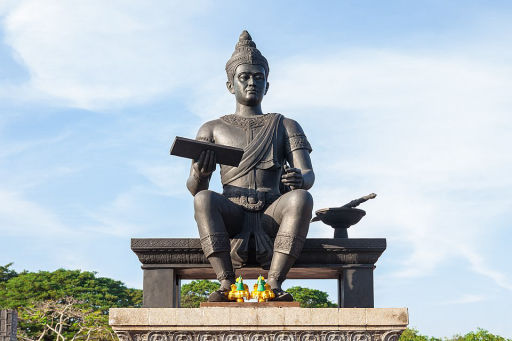
Quick Facts
Expanded Sukhothai’s influence, promoted trade and justice, and shaped Thai identity through inscriptions and governance reforms.
Conversation Starters
Life Journey
Born to Sri Indraditya, a founder of the Sukhothai polity, and Queen Sueang. He grew up as regional power shifted away from Khmer influence toward rising Tai principalities in northern Siam.
As a young prince, he learned mounted warfare, fortification defense, and court ceremony in Sukhothai. Senior nobles and Buddhist monks helped shape his views on kingship, merit, and public duty.
He gained early prestige by leading forces in frontier conflicts typical of mandala politics in mainland Southeast Asia. These campaigns strengthened Sukhothai’s bargaining power with neighboring muang and their rulers.
During the rule of his elder brother Ban Mueang, he emerged as a key strategist and administrator in the royal court. He helped manage tributary towns and maintain alliances that stabilized Sukhothai’s core territories.
He became king after Ban Mueang, inheriting a growing but delicate network of dependent cities. His reign emphasized both military credibility and paternal-style legitimacy described in later Sukhothai traditions.
Royal narratives portray him as accessible, with petition mechanisms symbolized by a bell at the palace gate. By reinforcing predictable dispute settlement, he improved stability for farmers, artisans, and long-distance merchants.
He supported Theravada Buddhist practice and patronized temples that anchored community life and royal legitimacy. Monks served as educators and record-keepers, linking Sukhothai to wider religious networks in the region.
He cultivated relationships with powerful neighbors, including rulers in Lan Na to the north and emerging centers in the Chao Phraya basin. Diplomatic marriages, tribute, and mutual defense pacts helped reduce costly wars.
Sukhothai’s court maintained contact with polities such as Hariphunchai and Mon centers, navigating shifting loyalties. These ties supported trade routes in forest products, ceramics, and rice between uplands and river plains.
Royal policy favored merchants and predictable tolls, enabling markets that connected Sukhothai to coastal and inland networks. Increased circulation of goods strengthened the king’s ability to reward allies and sustain garrisons.
Sukhothai participated in the tribute system associated with the Yuan court, expanding prestige and commercial access. Such exchanges linked the kingdom to Chinese luxury goods and technologies valued by Southeast Asian elites.
Kilns in the Sukhothai sphere produced high-quality glazed ceramics traded widely in the region. Court support for skilled craftsmen and kiln sites helped create a durable export identity for the kingdom’s economy.
The famous stele text, associated with his reign, describes governance ideals, prosperity, and a broad sphere of influence. Whether fully authentic or later-edited, it became central to Thai historiography and royal memory.
He balanced autonomy and obligation among outlying muang, relying on tribute, personal bonds, and strategic threat. This flexible system allowed expansion without direct bureaucratic control typical of later centralized states.
As neighboring powers strengthened, maintaining allegiance from distant towns became harder and more expensive. His court had to prioritize key corridors and allies rather than pursue continuous territorial enlargement.
He died after a long reign that later tradition remembered as a golden age of benevolent kingship. Subsequent chronicles and national narratives elevated him as a model ruler shaping early Thai identity and statecraft.