Quick Facts
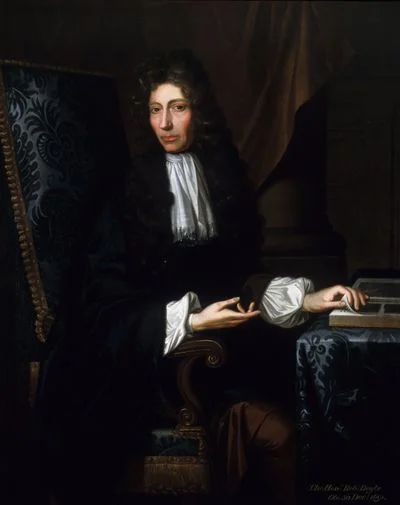
Boyle's Law. Father of modern chemistry who replaced alchemy with science.
Conversation Starters
Life Journey
Robert Boyle was born the fourteenth child of Richard Boyle, Earl of Cork, one of the richest men in Britain. His privileged birth gave him lifelong freedom to pursue science.
Young Robert was sent to Eton College for his formal education. He showed early intellectual promise and mastered Latin and other classical subjects.
Boyle embarked on a Grand Tour with his tutor, visiting France, Switzerland, and Italy. In Geneva, he learned French and studied mathematics with a private tutor.
During his time in Florence, Boyle studied the works of Galileo, who had recently died nearby. This exposure to experimental science profoundly influenced his future work.
Boyle returned to England during the Civil War, inheriting his father's estate at Stalbridge. He began conducting his first scientific experiments in his manor.
Boyle joined the 'Invisible College,' an informal group of natural philosophers dedicated to the new experimental science. This group would later become the Royal Society.
Boyle moved to Oxford, the center of English scientific activity. He set up a laboratory and began systematic experimental research with Robert Hooke as his assistant.
With Robert Hooke, Boyle constructed an improved vacuum pump. This device enabled groundbreaking experiments on the properties of air and vacuum.
Using his air pump, Boyle demonstrated that air was necessary for combustion and respiration. He showed that candles extinguish and animals die in a vacuum.
Boyle published his first major work describing air pump experiments. It established him as a leading figure in the new experimental philosophy.
Boyle published The Sceptical Chymist, attacking Aristotelian four-element theory and establishing the modern concept of chemical elements. This work founded modern chemistry.
Boyle discovered the inverse relationship between pressure and volume of gases at constant temperature: Boyle's Law. This fundamental principle became a cornerstone of physics.
Boyle became a founding charter member of the Royal Society, the world's oldest scientific academy. He served on its council for many years.
Boyle moved to London to live with his sister Katherine. He continued experiments and became central to London's scientific community despite declining health.
Boyle published studies on invisible emanations from substances, contributing to early understanding of what would later be understood as chemical reactions and atomic theory.
Boyle was elected President of the Royal Society but declined, refusing to take the required religious oath. His faith was private and sincere but unconventional.
Robert Boyle died one week after his beloved sister Katherine. He left funds in his will to establish the Boyle Lectures defending Christianity through reason.
Boyle is remembered as the 'Father of Modern Chemistry' for The Sceptical Chymist and Boyle's Law. His insistence on rigorous experimentation shaped the scientific method.