Quick Facts
From actress to empress. Ruled Byzantium beside Justinian with iron will.
Conversation Starters
Life Journey
Theodora was born into a family of low social status. Her father Acacius was a bear trainer at the Hippodrome, and after his death, her mother struggled to support three daughters in the competitive world of Byzantine entertainment.
When Theodora was young, her father died unexpectedly. Her mother quickly remarried hoping her new husband would inherit Acacius's position, but political machinations left the family destitute and dependent on public charity.
Following her older sister Comito onto the stage, Theodora became an actress and mime performer at the Hippodrome. In Byzantine society, actresses were associated with prostitution and held the lowest social status possible for a free woman.
Theodora left Constantinople as the companion of a Syrian official named Hecebolus, the governor of Pentapolis in Libya. The relationship ended badly when he abandoned her in Alexandria, forcing her to find her own way back to Constantinople.
Stranded in Alexandria, Theodora encountered Monophysite Christian teachings that would shape her spiritual life. She lived among religious communities and underwent a profound personal transformation, abandoning her former lifestyle.
Theodora returned to Constantinople as a changed woman, earning her living as a wool spinner near the palace. Her intelligence, beauty, and newfound piety would soon attract the attention of the heir to the throne.
Theodora embraced Monophysite Christianity, which believed Christ had one divine nature rather than the Orthodox two natures. This theological position would influence Byzantine religious policy throughout her life.
Theodora met Justinian, nephew of Emperor Justin I and heir to the throne. Despite her scandalous past and low birth, Justinian fell deeply in love with her intellect, beauty, and strength of character.
Roman law prohibited senators from marrying actresses. Justinian persuaded his uncle Emperor Justin I to change the law, demonstrating his determination to make Theodora his wife regardless of social convention.
Theodora married Justinian in an elaborate wedding ceremony at the Church of the Holy Wisdom. The former actress became a patrician and the most powerful woman in the empire, setting the stage for her remarkable rise.
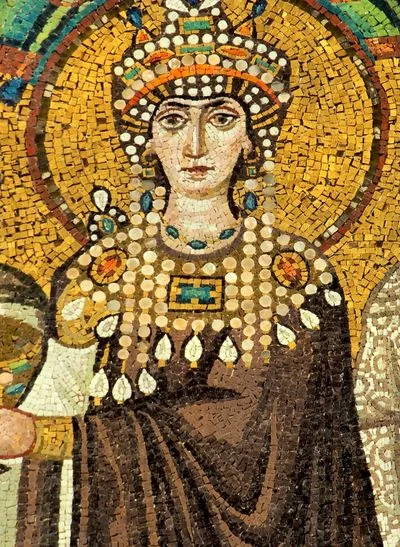
When Justinian became Emperor, Theodora was crowned Augusta and co-ruler. She received oaths of loyalty, received foreign ambassadors, and corresponded with foreign rulers as an equal partner in imperial governance.
When riots threatened to overthrow Justinian, his advisers urged flight. Theodora delivered her famous speech declaring she would rather die in imperial purple than flee, stiffening Justinian's resolve to crush the rebellion.
Theodora influenced laws protecting women from forced prostitution, allowing women to divorce abusive husbands, and granting mothers guardianship rights. She established a convent for reformed prostitutes called the Metanoia.
Despite official persecution of Monophysites, Theodora sheltered persecuted clergy within the palace grounds. She worked to reconcile Orthodox and Monophysite factions, maintaining her religious convictions while navigating imperial politics.
Theodora played a key role in religious diplomacy, including bringing Pope Vigilius to Constantinople. She wielded significant influence in church appointments and theological disputes between Rome and the Eastern churches.
Theodora actively participated in foreign policy, corresponding with Persian queens and influencing diplomatic strategies. She received foreign ambassadors and helped negotiate treaties, demonstrating her role as true co-ruler.
When the bubonic plague struck Constantinople, Theodora remained steadfast while Justinian himself fell gravely ill. She helped maintain government operations during the crisis that killed perhaps a third of the city's population.
Theodora died of cancer, leaving Justinian devastated. He honored her memory for the remaining seventeen years of his reign, rarely making major decisions without invoking her name. She is venerated as a saint in the Eastern Orthodox Church.