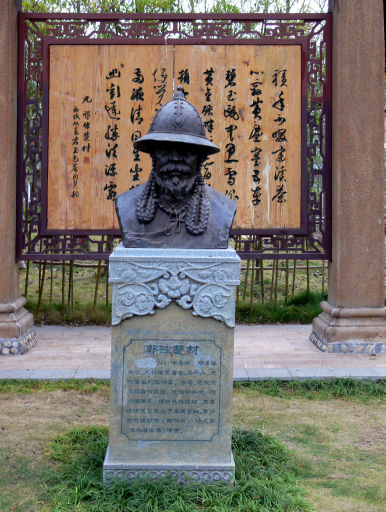
Quick Facts
A Khitan scholar-statesman who guided Mongol governance, championing taxation, law, and learned administration over plunder.
Conversation Starters
Life Journey
Born to the Khitan Yelu aristocratic lineage as the Jurchen-led Jin dynasty ruled North China. Raised amid shifting frontiers, he inherited both steppe heritage and Chinese classical learning in a world of competing empires.
As a youth he studied Confucian texts, historical chronicles, and administrative writing used by Jin officials. Tutors emphasized practical governance and moral persuasion, skills he later applied when advising Mongol rulers over Chinese subjects.
He began official life under the Jin administration, learning law, taxation practices, and court procedure. The experience exposed him to the strengths and brittleness of Jin governance as Mongol power grew on the northern steppe.
When Genghis Khan launched major campaigns against the Jin dynasty, he saw cities mobilize and frontier defenses strain. The violence and displacement convinced him that durable rule required institutions, revenue, and administrators—not only conquest.
After the Mongols captured Zhongdu, the Jin court’s authority in the north collapsed. He navigated the political rupture by presenting his skills as a literate administrator, positioning himself to influence the conquerors’ approach to governance.
He was brought into the Mongol imperial circle, where his learning and clear counsel stood out among military advisers. Serving Genghis Khan, he framed policy in terms of revenue, legitimacy, and control over conquered agrarian populations.
As Mongol armies moved toward Central Asia, he helped manage logistics, records, and the treatment of captives and towns. His writings from travel emphasized the cost of devastation and the strategic value of keeping skilled people alive.
He repeatedly argued that slaughter and ruin destroyed future revenues and made later control harder. By linking mercy to fiscal benefit, he offered steppe commanders a language they respected while quietly advancing a more humane policy.
As the empire consolidated, he proposed using census and tax registers to stabilize newly conquered regions. He recommended retaining experienced clerks and applying consistent levies, creating continuity that Mongol rulers could deploy at scale.
Genghis Khan died during the campaign against Western Xia, triggering a delicate transition. He supported orderly succession arrangements and emphasized that stable institutions would protect the imperial family’s interests across vast territories.
With Ogedei’s enthronement, he gained stronger authority to shape civil governance over North China. He urged the khan to rely on regular taxation and supervised officials, arguing that predictable income outlasted one-time plunder.
He helped organize household registration and tax collection to fund the court and armies. Working with regional administrators, he promoted standardized assessments so Mongol rule could extract revenue without collapsing local agriculture and markets.
After the Jin dynasty was eliminated, North China required a new administrative framework. He guided appointments, fiscal rules, and legal practices to keep order among diverse populations, balancing Mongol authority with Chinese bureaucratic methods.
He oversaw reforms to increase predictable state income, emphasizing land and household taxation over arbitrary seizures. By presenting clear accounting to Ogedei Khan, he strengthened the idea that an empire could be both conqueror and administrator.
He wrote poems and reflective notes that blended Confucian moral language with observations of steppe power. His works recorded landscapes, court life, and the human cost of conquest, shaping later perceptions of early Mongol governance.
Ogedei Khan’s death intensified factional politics and scrutiny of senior administrators. He defended revenue policies and bureaucratic appointments while trying to keep institutions functioning, even as regency politics threatened reform continuity.
He died after a career spent translating conquest into workable governance for a multiethnic empire. Later generations remembered him as a rare scholar-official who could speak to khans in their interests while restraining violence through policy.