간략 정보
A brilliant Indian astronomer-astrologer who fused mathematics, observation, and tradition into enduring scientific and literary classics.
대화 시작하기
인생 여정
Varahamihira was born in northern India as Gupta influence shaped education, Sanskrit scholarship, and mathematical astronomy. Later traditions connect him with Ujjain, a key center for astronomical computation and learned debate.
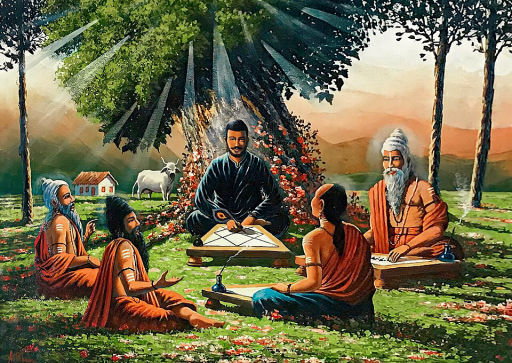
As a youth he studied Sanskrit grammar, arithmetic, and the jyotisha disciplines of astronomy and astrology. Instruction likely drew on siddhanta handbooks and teacher-led oral explanation, emphasizing algorithms and calendrical practice.
He learned to compute planetary positions, eclipses, and lunar phases using established parameters and correction schemes. Practical work with timekeeping and calendars tied scholarly theory to ritual schedules and administrative needs.
Ujjain functioned as a hub where scholars compared results, refined constants, and debated competing siddhantas. Varahamihira’s reputation grew as he demonstrated both computational skill and command of earlier authorities in Sanskrit.
He started organizing older astronomical systems into a coherent comparative framework for students and practitioners. This work preserved methods circulating in India and highlighted differences in parameters, epochs, and correction procedures.
He wrote the Panchasiddhantika to summarize five major astronomical canons, including the Surya, Romaka, and Paulisa traditions. By comparing methods and constants, he created a technical bridge between diverse computational schools.
In discussing the Romaka and Paulisa siddhantas, he recorded techniques associated with western astronomical practice. His careful presentation shows how Indian scholars absorbed and localized foreign parameters without abandoning Sanskritic frameworks.
He worked on step-by-step schemes for predicting eclipses and modeling planetary motion with corrections. Such refinements improved calendar reliability for courts, temples, and astrologers who depended on accurate timing and ephemerides.
He composed Brihat Jataka to systematize natal astrology in crisp Sanskrit verses used by practitioners. The text organized house meanings, planetary combinations, and interpretive rules that later commentators expanded across South Asia.
Varahamihira’s writings began circulating among students who memorized verses and learned worked examples. Ujjain’s scholarly environment encouraged commentary, prompting later exegetes to clarify algorithms and interpretive canons in detail.
He wrote Brihat Samhita as a wide-ranging compendium linking astronomy with weather lore, architecture, omens, and social practices. It offered guidance for planners and patrons, reflecting how scientific calculation served public and ritual life.
In Brihat Samhita he discussed cloud types, rainfall indicators, and seasonal cycles using observational cues and traditional correlations. These passages show an effort to regularize environmental knowledge for agriculture and governance under monsoon uncertainty.
He treated site selection, building proportions, and auspicious timing as practical arts informed by cosmology and measurement. By addressing craftsmen and patrons, he positioned scholarly jyotisha as a tool for concrete design decisions.
His reputation drew interest from patrons who valued accurate calendars, prognostication, and learned prestige. Through such networks his texts spread beyond Malwa, shaping curricula and practice in multiple regions of the subcontinent.
Later scholars treated Varahamihira as a reliable synthesizer of older siddhantas and a master of concise exposition. His verses were copied, taught, and glossed, making his works central to medieval Indian scientific literature.
Scribes and students preserved his compositions in manuscript collections used for instruction and professional consultation. The continued demand for his algorithms and interpretive rules ensured frequent copying and regional transmission.
Varahamihira died leaving a body of work that defined standards for astronomical compendia and astrological manuals. His synthesis helped preserve diverse traditions and influenced generations of Indian scholars, calculators, and commentators.