Quick Facts
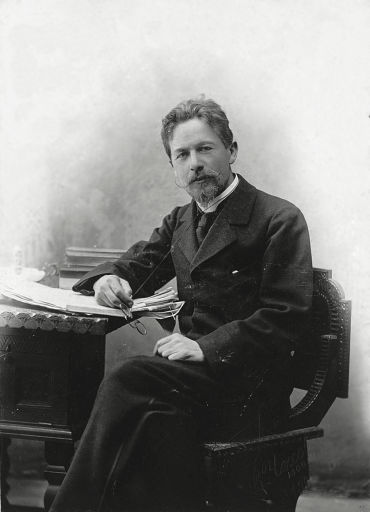
A physician-writer who transformed modern drama and short fiction with subtle realism, compassion, and razor-sharp observation.
Conversation Starters
Life Journey
Born to Pavel Yegorovich Chekhov and Yevgeniya Yakovlevna in the port city of Taganrog on the Sea of Azov. His father’s strictness and the household’s financial strain later fed his sharp, compassionate realism.
He began studies at the Taganrog Gymnasium, receiving a classical education in literature, languages, and religion. School theatre and reading helped cultivate the observational style that later defined his fiction and plays.
After Pavel Chekhov’s business collapsed, the family moved to Moscow to escape debts and creditors. Anton stayed behind in Taganrog to finish school, supporting himself through tutoring and living frugally and alone.
He joined his family in Moscow and enrolled in the medical faculty of Moscow University. To pay expenses he began publishing short comic sketches, training a concise style under tight editorial deadlines.
His early humorous pieces appeared in popular magazines and newspapers, often signed 'Antosha Chekhonte.' The lively Moscow press scene taught him pacing and dialogue while he balanced lectures, clinics, and family obligations.
He graduated from Moscow University and obtained his medical qualification, practicing as a doctor for the poor. Medicine became his ethical anchor, and he later called it his lawful wife, with literature as his mistress.
Editors such as Dmitry Grigorovich urged him to move beyond sketches into serious fiction, and leading journals began printing his work. His tone shifted toward quiet tragedy and moral ambiguity, capturing ordinary lives without melodrama.
The Russian Academy of Sciences awarded him the Pushkin Prize for 'At Dusk' (V sumerkakh), confirming him as a leading prose writer. The honor broadened his readership and gave him leverage with major literary publishers.
He published the long story 'The Steppe,' praised for its vivid landscapes and psychological nuance. The work showed he could sustain a larger canvas while keeping his trademark restraint and attention to small human gestures.
He undertook a grueling journey across Siberia to Sakhalin, then a notorious penal colony in the Russian Far East. Interviewing prisoners and settlers, he gathered data like a social scientist, exposing harsh conditions and state neglect.
He purchased the Melikhovo estate outside Moscow and became deeply involved in rural public life. Chekhov treated peasants, helped build schools, and worked with local officials during cholera threats, blending civic duty with writing.
His story 'Ward No. 6' offered a bleak, philosophical portrait of institutional cruelty and moral complacency. It resonated amid debates about reform in late imperial Russia and became one of his most discussed works.
The first staging of 'The Seagull' at the Alexandrinsky Theatre was met with confusion and hostility, and the performance collapsed into jeers. The failure deeply shook him and temporarily soured him on theatrical life in Petersburg.
Konstantin Stanislavski and Vladimir Nemirovich-Danchenko staged 'The Seagull' at the Moscow Art Theatre and turned it into a triumph. Their ensemble style matched Chekhov’s subtext and pauses, launching a landmark collaboration.
He married Olga Knipper, a leading actress of the Moscow Art Theatre, after a courtship shaped by travel and illness. Tuberculosis often forced separations, yet their letters reveal artistic partnership and affectionate, practical support.
He was elected an honorary academician by the Imperial Academy of Sciences for literature, a rare public honor. When Maxim Gorky’s election was annulled for political reasons, Chekhov resigned in protest, signaling moral solidarity.
The Moscow Art Theatre premiered 'The Cherry Orchard,' with Stanislavski emphasizing tragedy while Chekhov insisted on its comic undertones. The play became a farewell portrait of a class in decline amid Russia’s accelerating social change.
Suffering advanced tuberculosis, he traveled with Olga Knipper to the German spa town of Badenweiler for treatment. He died there in July 1904, and his body was returned to Russia, where admirers mourned a modern literary pioneer.