Quick Facts
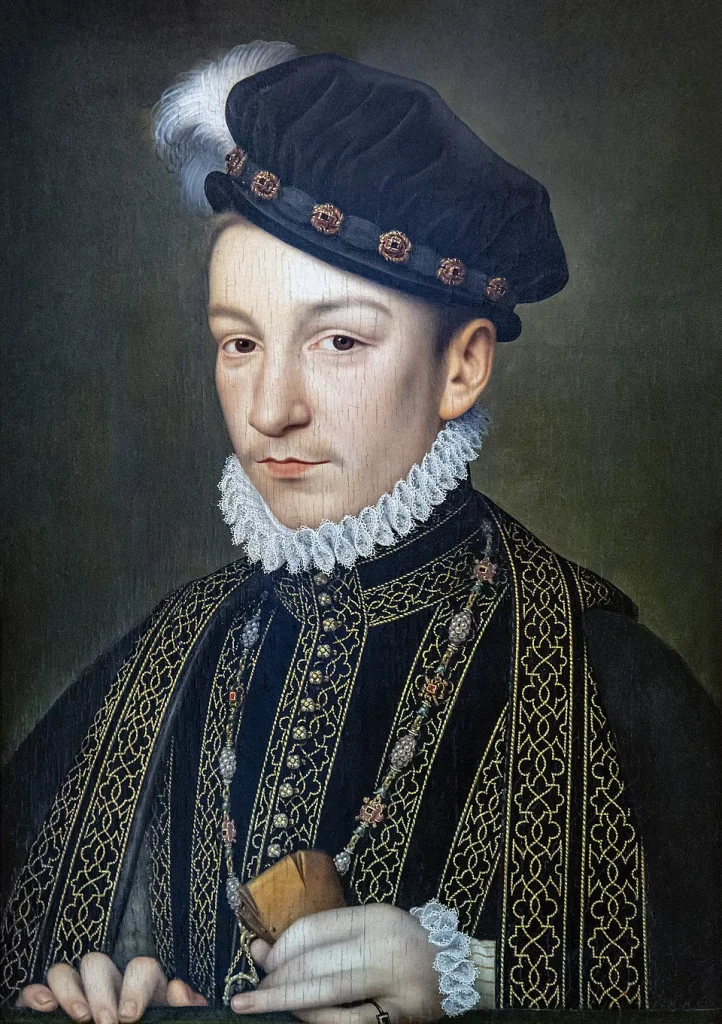
Young king haunted by St. Bartholomew's Day. Ruled France while his mother pulled the strings.
Conversation Starters
Life Journey
Charles-Maximilien was born on June 27, 1550, as the third son of King Henry II and Catherine de' Medici. He was not expected to become king.
King Henry II was killed in a tournament accident. Charles's older brother Francis became king, with their mother Catherine gaining influence.
After Francis II's premature death, ten-year-old Charles became King Charles IX. His mother Catherine de' Medici served as regent, dominating government.
The Wars of Religion between Catholics and Huguenots erupted. Charles's reign would be defined by this brutal religious civil war.
Charles was declared of age at thirteen, though Catherine continued to dominate policy. He showed interest in hunting and poetry but little aptitude for government.
Charles and the court undertook a two-year tour of France to show the young king to his subjects and attempt reconciliation between religious factions.
War erupted again after the Surprise of Meaux. Charles increasingly fell under the influence of Admiral Coligny, a Huguenot leader.
Charles developed a close relationship with the Huguenot leader Coligny, calling him 'father.' This alarmed Catherine and the Guise faction.
The Peace of Saint-Germain ended the Third War of Religion, granting significant concessions to the Huguenots. Catherine worked for reconciliation.
Charles married Elisabeth of Austria, daughter of the Holy Roman Emperor. The marriage was happy, and Elisabeth brought stability to the troubled court.
Admiral Coligny became Charles's chief advisor, pushing for war with Spain to unite France. Catherine grew increasingly alarmed at losing control.
Charles's sister Marguerite married the Huguenot Henry of Navarre in Paris. The wedding gathered Huguenot leaders in the capital.
An assassination attempt wounded Coligny. Charles visited him and promised justice, but Catherine and the Guises plotted a more comprehensive solution.
On August 23, 1572, Charles was persuaded to order the killing of Huguenot leaders. The massacre that followed killed thousands across France.
The massacre reportedly haunted Charles. Some accounts claim he participated in shooting Huguenots. His mental and physical health deteriorated rapidly.
War resumed as Huguenots fought for survival. The siege of La Rochelle failed, and Charles's health continued to decline.
Charles's only legitimate child, Marie Elisabeth, was born. He had an illegitimate son, Charles de Valois, by his mistress Marie Touchet.
Charles IX died on May 30, 1574, of tuberculosis, possibly worsened by guilt and mental anguish. His last words allegedly expressed remorse for the massacre. He was succeeded by his brother Henry III.