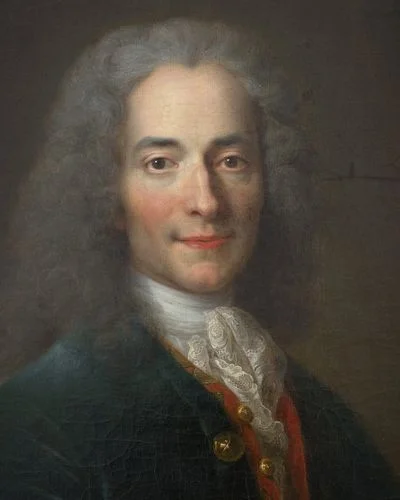
Quick Facts
I disapprove of what you say, but...": Voltaire, freedom's sharp pen.
Conversation Starters
Life Journey
François-Marie Arouet, later known as Voltaire, was born on November 21, 1694, to François Arouet, a prosperous notary, and Marie Marguerite d'Aumart in Paris. He was the youngest of five children, though only three survived to adulthood. His father wanted him to become a lawyer.
Voltaire began his education at the prestigious Jesuit Collège Louis-le-Grand, one of France's finest schools. Here he received a classical education in Latin, rhetoric, and theology. He developed his love for literature and theater, and his wit and irreverent humor began to emerge.
After completing his education, Voltaire studied law as his father wished but soon abandoned it for literature. He began frequenting Parisian literary salons, where his sharp wit and satirical verse gained him both admirers and enemies among the aristocracy.
Voltaire accompanied the French ambassador to The Hague but was sent home in disgrace after a love affair with a Protestant refugee. This early scandal foreshadowed his lifelong talent for controversy. His father threatened to disinherit him if he did not pursue a proper profession.
Voltaire was imprisoned in the Bastille for eleven months for writing satirical verses mocking the Regent, Philippe II, Duke of Orléans. During his imprisonment, he worked on his first major play and adopted the pen name Voltaire. This experience deepened his hatred of arbitrary authority.
Voltaire's tragedy Oedipus premiered at the Comédie-Française and was an enormous success, establishing him as France's leading playwright. The play's themes of tyranny and justice reflected his own experiences with oppression. He officially adopted the name Voltaire, leaving François-Marie Arouet behind.
Voltaire published La Henriade, an epic poem celebrating Henry IV of France and religious tolerance. The work praised the Edict of Nantes and criticized religious fanaticism. It brought him fame across Europe and established him as more than just a playwright.
After being publicly beaten by servants of the Chevalier de Rohan-Chabot following a quarrel, Voltaire challenged the noble to a duel. He was briefly imprisoned in the Bastille again, then exiled to England. This humiliation at the hands of aristocratic privilege profoundly shaped his views on justice.
During his three years in England, Voltaire learned English and studied the works of John Locke, Isaac Newton, and Shakespeare. He attended Newton's funeral and was impressed by English religious tolerance and constitutional government. These experiences transformed his philosophical outlook.
Voltaire began his intellectual and romantic partnership with Émilie du Châtelet, a brilliant mathematician and physicist. They lived together at her husband's château at Cirey for fifteen years, collaborating on scientific and philosophical works. She translated Newton's Principia into French.
Voltaire published his Philosophical Letters, also known as Letters on the English, praising English institutions and implicitly criticizing French society. The book was condemned by the French parliament and burned, forcing Voltaire to flee Paris. It became a foundational text of the Enlightenment.
Voltaire accepted Frederick the Great's invitation to join the Prussian court as a philosopher-in-residence. Initially a fruitful collaboration, the relationship deteriorated due to quarrels and jealousies. Voltaire left Prussia in 1753 after Frederick had him detained and humiliated at Frankfurt.
Voltaire settled near Geneva and purchased the estate of Ferney just across the French border, giving him the ability to flee to either country if persecuted. Ferney became his final home and a pilgrimage site for Enlightenment admirers. He transformed the village into a prosperous community.
Voltaire published Candide, his masterpiece of satirical fiction. The novella attacked the philosophy of optimism, religious hypocrisy, and human cruelty. Its famous conclusion, we must cultivate our garden, became a symbol of practical philosophy. Candide remains one of the most widely read works of the Enlightenment.
Voltaire championed the case of Jean Calas, a Protestant merchant wrongfully executed for allegedly murdering his son. His campaign against judicial murder and religious persecution lasted years and eventually led to Calas's posthumous exoneration. Écrasez l'infâme! (Crush the infamous thing!) became his rallying cry against intolerance.
Voltaire published his Philosophical Dictionary, a portable compendium of Enlightenment thought disguised as an alphabetical reference work. Its witty, devastating attacks on superstition, religious intolerance, and irrational authority made it one of the most dangerous books of the century. It was burned in Paris and Geneva.
After nearly thirty years of exile, Voltaire returned to Paris in February 1778. He was received as a hero, crowned with laurels at the Comédie-Française during a performance of his play Irène. The crowds who gathered to see him were so large that he feared being crushed. Benjamin Franklin brought his grandson for Voltaire's blessing.
Voltaire died on May 30, 1778, at age 83. The Catholic Church denied him a Christian burial due to his attacks on religion, but his friends smuggled his body to the Abbey of Scellières for interment. During the French Revolution, his remains were transferred to the Panthéon, where he rests as one of France's greatest thinkers.